Wednesday, July 15, 2020

Wednesday, 15 July 2020—Day 3


Welcome to the Wednesday edition of your favorite screenshot game.  As is customary, today's lineup is noticeably tougher than yesterday's—a bit like swinging the leaded bat in the on-deck circle to ready you for tomorrow.  Here are the correct titles for Day 2's movies:

1.
A Christmas Story (1983)

2.
It's a Wonderful Life (1946)

3.
Sunset Blvd. (1950)

4.
Airplane! (1980)

5.
Elf (2003)

6.
Stand by Me (1984)

7.
To Kill a Mockingbird (1962)

8.
His Girl Friday (1940)

9.
Ninotchka (1939)

10.
Psycho (1960)


Congratulations to freddy and catbert for correctly identifying all 10 of Tuesday's films.

Let's get to today's game.  Are you ready to play?  Then let's play.  But first, two buffer images:


Tyrone Power and Linda Darnell in The Mark of Zorro (1940)


Rita Hayworth on the cover of Life magazine, in costume for the title role in Gilda (1946).


Good luck and have fun!


1.


2.


3.


4.


5.


6.


7.


8.


9.


10.


Tuesday, July 14, 2020

Tuesday, 14 July 2020—DAY 2


Welcome back to Bookman's Movie Screenshot Game.  If it's Tuesday, the game must be a bit tougher than Monday's but not as tough as tomorrow's.

Here are the correct titles for Day 1's screenshots:

1.
Frankenstein (1931)

2.
Young Frankenstein (1974)

3.
The Adventures of Robin Hood (1938)

4.
Raiders of the Lost Ark (1981)

5.
Ghostbusters (1984)

6.
Forrest Gump (1994)

7.
Fargo (1996)

8.
Pulp Fiction (1994)

9.
Dances with Wolves (1990)

10.
Jaws (1975)


Congratulations to catbert for correctly identifying all ten movies.  I'm glad you're playing, catbert.

But, are you ready to play today?  All right then, let's play!  The buffer images are next and then the first screenshot of the day.


Ann Harding, June 1930 cover of Photoplay magazine


Rudolph Valentino, September 1926 cover of Motion Picture magazine, commemorating his recent death.  More than 100,000 people gathered at his funeral in New York City.


Good luck and have fun!


1.


2.


3.


4.


5.


6.


7.


8.


9.


10.


Monday, July 13, 2020

Monday, 13 July 2020—Day 1


Hello movie fans!  Welcome to another 2-week engagement of Bookman's Movie Screenshot Game.  I post the screenshots here, you post the movie titles in the comments section below or in the appropriate thread at FPN.

As always, the games run Mondays through Thursdays.  Each day there will be 10 screenshots, arranged somewhat in descending order of difficulty.  Today's game should be easy, though.  The games do get a bit tougher each day.  Thursdays games will be challenging.  Sometimes Thursday's #10 can be a head-scratcher.  On the second Monday, however, we dial the difficulty back down to easy.

The correct titles for each game will be posted at the top of the next day's game.  There are no Friday games, and so Thursday's correct titles will be posted separately on Friday.

Unlike last time, all posts will occur at the new time of 9:00 A.M. U.S. Pacific Time (GMT – 8:00).

Between the daily introduction and the game's screenshots I post two "buffer images" to prevent your seeing the first screenshot prematurely.

Here are today's buffer images.


John Barrymore as Hamlet, 1922.


Clark Gable and Mickey Rooney on the set of Manhattan Melodrama (1934)


Are you ready to play?  All right, let's play!

Good luck, and have fun!


1.


2.


3.


4.


5.


6.


7.


8.


9.


10.


Monday, July 6, 2020

Screenshot for the Week of 05 July 2020: "HIGH NOON" (1952)


Gary Cooper as Marshal Will Kane in High Noon (1952)

The Year 1952 was rife with paradox, irony, and fear in the movie industry.  That year yielded seven great films, none of which won the Oscar for Best Picture.  It was the year of High Noon; The Bad and the Beautiful; Viva Zapata!; The Quiet Man; Come Back, Little Sheba; Forbidden Games; and Singin' in the Rain.  The Oscar for Best Picture of 1952 went to a good but not great film, The Greatest Show on Earth.

Carl Foreman's script for High Noon is a classic.  It was nominated for an Oscar but lost to The Bad and the Beautiful.  I think Foreman's script was better, but the loss wasn't a miscarriage of justice.  After all, The Bad and the Beautiful won 5 Oscars, more than any other film that year.

🌎🌎🌎

High Noon is an allegory for the "red scare" in postwar America and for the way Hollywood—actors, producers, writers, directors, studio bosses—failed to rise up, stand united, and protect their own in the face of Congressional bullying.  In trying to find and root out Communists and Communist influence in Hollywood, the House Committee on Un-American Activities menaced witnesses who did not unabashedly and unhesitatingly cooperate and "name names"—i. e., expose members of the film industry that had even a remote connection to Communism.

If it were discovered that you had taken a leaflet from someone on the street that turned out to be Communist propaganda—even if you had immediately shoved it into your pocket without looking at it and thrown it away when you got home—you would be labeled a suspected Communist or Communist sympathizer.  If you had eaten a meal one time in a restaurant that was later identified as a Communist hangout; if a distant relative had been labeled a Communist or sympathizer; if you had gone to a party where Communists or sympathizers had been present, you would be labeled a suspected Communist or Communist sympathizer.  In or out of Hollywood you would lose your job.  Friends and colleagues would shun and avoid you.

The film industry was complicit in the bullying by way of its off-the-record "blacklist."  The "Hollywood Blacklist" was a poorly-kept secret that, for decades, Hollywood insiders denied ever existed.  But too many memoirs and first-person accounts of the blacklist have put that canard in its grave.  Indeed there was a blacklist and it was enforced.

It was the age of widespread fear.  It was the age of the second "red scare" of the 20th century.  It was the age of Julius and Ethel Rosenberg, Whitaker Chambers, the "atom bomb" and the soul-killing fear of "World War III."  It was the age of Joseph R. McCarthy, his henchman Roy Cohn, and Congressman Richard Nixon.  Few dared to stand up to the bullying.  Carl Foreman was one who did, and in return he was blacklisted from working in Hollywood.  But before he was blacklisted, he wrote High Noon.

🌎🌎🌎


Floyd Crosby (father of rocker David Crosby [The Byrds; Buffalo Springfield; Crosby, Stills, Nash, and Young]) was the Director of Photography on this film.  What's the difference between a cinematographer and a director of photography?  Answer: the level of artistic control over the cinematography.

The high-contrast black-and-white of High Noon was conceived and executed by Crosby and makes the visual imagery as stark as the story and action.  Director Fred Zinnemann had a vivid mental storyboard of how the action should play out.  His firm grasp on his subject no doubt helped Crosby tremendously.  If only ….  If only High Noon had been Crosby's lone film credit, he might have been considered among the world's greatest cinematographers.  Alas, it wasn't and he isn't.

Crosby's resume is unimpressive.  And thus his credit for High Noon stands out as if it were in all caps or red letters.  His work on that film is the work of a true artist at the top of his game.  I spent the time to take screenshots of High Noon from start to finish, following Crosby around, shooting what he shot.  I ended up taking only 57, but nearly every one is perfectly framed.  Here are a few examples.


🌎🌎🌎


Gary Cooper was a lifelong conservative Republican.  I don't know whether he hesitated in taking the role of Will Kane and whether the hesitation, if it happened, was political.  But Fred Zinnemann's first choice—Gregory Peck—turned the role down and it was then offered to Cooper.  His popularity had dropped in the previous seven or eight years.  Perhaps he saw this as a comeback opportunity.  It most certainly was.

Many critics and, doubtless, many filmgoers were disturbed by the age gap between Cooper and Grace Kelly.  Cooper was 51 and Kelly was 21.  Cooper and Kelly had no problem with it.  In fact they carried on an affair during the entirety of the filming.

🌎🌎🌎


Some blacklisted writers continued to work in Hollywood off-the-record, literally.  Their screen credits were given over to fake names.  At least four of their screenplays won Oscars: Roman Holiday (1953), written by Dalton Trumbo; The Brave One (1956), also by Trumbo; The Bridge on the River Kwai (1957), co-written by Carl Foreman and another blacklisted writer, Michael Wilson; and The Defiant Ones (1958), co-written by Nedrick Young.  Decades later, they finally received their credits when their real names were restored to the films and to the official records.

🌎🌎🌎


High Noon director Fred Zinnemann's next movie was From Here to Eternity (1953).  It won the Oscar for Best Picture of 1953 and he won an Oscar for his direction.

DoP: Floyd Crosby.  D: Fred Zinnemann.

Monday, June 29, 2020

Screenshot for the Week of 29 June 2020: "THE MAGNIFICANT SEVEN" (1960)


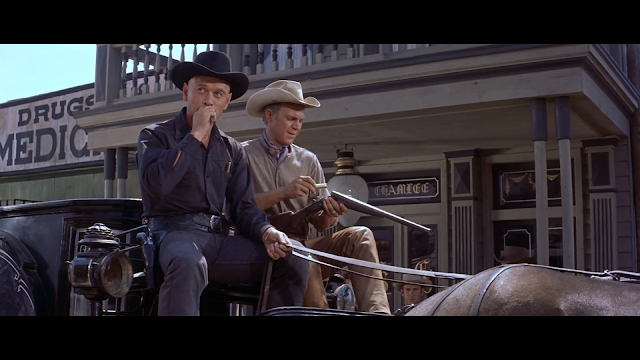
Chris (Yul Brynner) bites the end off a cigar as he prepares to drive a hearse to Boot Hill.  Vin (Steve McQueen), riding shotgun, has just finished shaking the shot inside two shells, one shell at a time, and is now loading the shells into his shotgun in The Magnificent Seven (1960).

Mickey Rooney was a notorious scene-stealer.  (I'm going somewhere with this.)  He had various ways to snatch the audience's attention away from other actors, often by fiddling with something in his hands.  Spencer Tracy was an early victim of Rooney's, and afterward Tracy played the same trick on fellow actors for the rest of his career.

In 1960, Yul Brynner was an established film star.  He had won the Oscar for Best Actor in 1957 for his memorable performance in The King and I (1956).  Steve McQueen, on the other hand, was a relative upstart, a TV actor, which at that time was lower than a second-class citizen in the acting world.

Despite his TV popularity due to his work on the western Wanted:Dead or Alive!, McQueen was trying as a film actor to live down the infamy of his amateurish performance in the laughable horror movie, The Blob (1958).  Nevertheless, using Rooney's and Tracy's tricks, McQueen risked getting fired from The Magnificent Seven by his successful and rather obvious efforts to upstage Brynner at the beginning of this scene—shaking the shotgun shells noisily next to his right ear, one at a time; removing his hat and looking up at the second storeys and rooftops, rotating his head as if scanning windows and balconies while using the hat to shade his eyes.  Brynner feebly tried to keep pace with McQueen by removing a cigar from his pocket, biting the end off, spitting it out, and then lighting the cigar.  But he had already lost the audience.  All eyes were on McQueen.  The two actors did not get along well on set after that.


Unbeknownst to both actors, Brynner's stardom was on the wane in 1960 while McQueen's was about to take off.  Indeed, The Magnificent Seven made McQueen a legitimate big-screen movie star and the very personification of cool.

🌎🌎🌎

The Magnificent Seven (1960) is John Sturges's homage to Akira Kurosawa's Seven Samurai (1954).  [SPOILER ALERT!] In the scene that sets up the story and plot of Kurosawa's classic, an unemployed samurai moseys into a village and learns that a young girl has just been kidnapped and taken into a nearby hut.  The men of the village are afraid to intervene because the kidnapper works for a dreaded local warlord whose band of marauders have for years terrorized the village, killing peasants at will, looting their farms, and raping women.  The samurai wastes no time in walking into the hut.  We hear a brief scuffle, and the samurai walks out of the hut with the girl and no sign of the kidnapper.

[SPOILER ALERT! CONTINUES] I took the above screenshot from the parallel scene in The Magnificent Seven, which sets up a different story but in a similar plot.  In an act of racial progressiveness, Chris (Yul Brynner) and Vin (Steve McQueen) volunteer to drive a hearse to Boot Hill carrying the coffin of an Indigenous American.  A racist and armed white mob has formed at the cemetery, intending to prevent the Indigenous man's burial there. [END OF SPOILER ALERT!]

This scene is an artistic wonder.  The cinematography of Charles Lang shows the effective work of a craftsman keeping it simple and not saying, "Look at me!  I'm the cameraman!  Look at what I can do!"  The actors are comfortable in their characters.  The dialogue is brilliant in its economy.  The action is telegraphed and, for our purposes, needn't be otherwise.  This is one of my favorite scenes in a John Sturges movie.


C: Charles Lang.  D: John Sturges.

Screenshot of the Month: "L.A. Confidential" (1997)

Russell Crowe ("Officer Bud White") dangling  Ron Rifkin ("District Attorney Ellis Loew") out an L.A.P.D. upper  floor o...