Showing posts with label New York Movie. Show all posts

Sunday, November 22, 2020

Screenshot for the Week of 23 November 2020: "NORTH BY NORTHWEST" (1959)

Cary Grant, Eva Marie Saint, James Mason, and Martin Landau in North By Northwest (1959).  C: Robert Burks.  D: Alfred Hitchcock.

Alfred Hitchcock is my favorite director, and North by Northwest is my favorite Hitchcock film.  It is #3 on my list of all-time favorite films, just behind Casablanca (1942) and Chinatown (1974).  Six of Hitchcock's films are in my top 101, and three are in my top 25.  (Rear Window [1954] is #8 and The 39 Steps [1935] is #18.)(Macreedy is my imdb handle.)

🌎🌎🌎

Robert Burks photographed eleven of Hitchcock's films, beginning with Strangers on a Train (1951) and ending with The Birds (1963), although he didn't work on every Hitchcock film in that period.  While Hitchcock occasionally worked with other cinematographers, Burks worked with other directors as well.  He shot Hondo (1953) for John Farrow, The Vagabond King (1956) for Michael Curtiz, The Spirit of St. Louis (1957) for Billy Wilder, and The Music Man (1962) for Morton DaCosta.  Burks was nominated for an Oscar four times and won for To Catch a Thief (1955).

🌎🌎🌎

Screenwriter Ernest Lehman is one of the greatest screenwriters almost no one has ever heard of.  But you've heard of the movies he has written or adapted for the screen: Sabrina (1954), The King and I (1956), Somebody Up There Likes Me (1956), Sweet Smell of Success (1957), North by Northwest, West Side Story (1961), The Sound of Music (1965), and Who's Afraid of Virginia Woolf? (1966), among others.

Censors poured over North by Northwest, especially the script.  They forced a change in the dialogue in the scene on the train with Roger Thornhill (Cary Grant) and Eve Kendell (Eva Marie Saint).  Kendell says in the original script, "I never make love on an empty stomach."  To appease censors, Lehman changed it to "I never discuss love on an empty stomach."  When you watch the movie, watch Eva Marie Saint's lips when she delivers her line.  Hitchcock simply looped her new line in and didn't reshoot the scene.  You can see her clearly say "make love" while you hear "discuss love."

The censors were hesitant to allow the character Leonard (Martin Landau) to even appear to be possibly gay, and they wouldn't allow the script to take it further.  During filming, however, Lehman added a line for Leonard that wasn't in the script censors reviewed: "Call it my woman's intuition."  It slipped through the censor's net.  And they didn't catch the symbolism of the train entering the tunnel at the end of the movie either.

🌎🌎🌎

Cary Grant was the ideal actor to play Roger Thornhill.  William Holden was briefly considered but never offered the job.  If you think about it, had Grant not been available, Hitchcock could've made this movie with Holden as Thornhill and not lost much, if anything, in the characterization.

Hitchcock filmed one scene at the Plaza Hotel, the one where Thornhill walks into the hotel and down a corridor toward the "Oak Bar" (a common, unofficial nickname for the Oak Room).  They didn't film inside the Oak Room itself but at MGM Studios in Culver City where an exact replica of the Oak Room was painstakingly built.  In fact, all the shooting inside the Plaza Hotel was done with one take.  Grant walked into the hotel, down the corridor, turned the corner, and went straight to the room that MGM had provided him at the Plaza, which he had insisted on as part of his deal.  He was done for the day.

🌎🌎🌎

Ambassador Hotel, Chicago

In North by Northwest, on the way to their destinies, Van Dam and company stay at the Ambassador East (now Ambassador Chicago), which opened in Chicago in 1926.

Ambassador, New York

The Ambassadors were a chain of luxury hotels, the first having been opened in Atlantic City in 1919.  The Ambassador New York on Park Avenue opened in 1921.  Like the other Ambassadors, it was a hotbed of top flight entertainment.


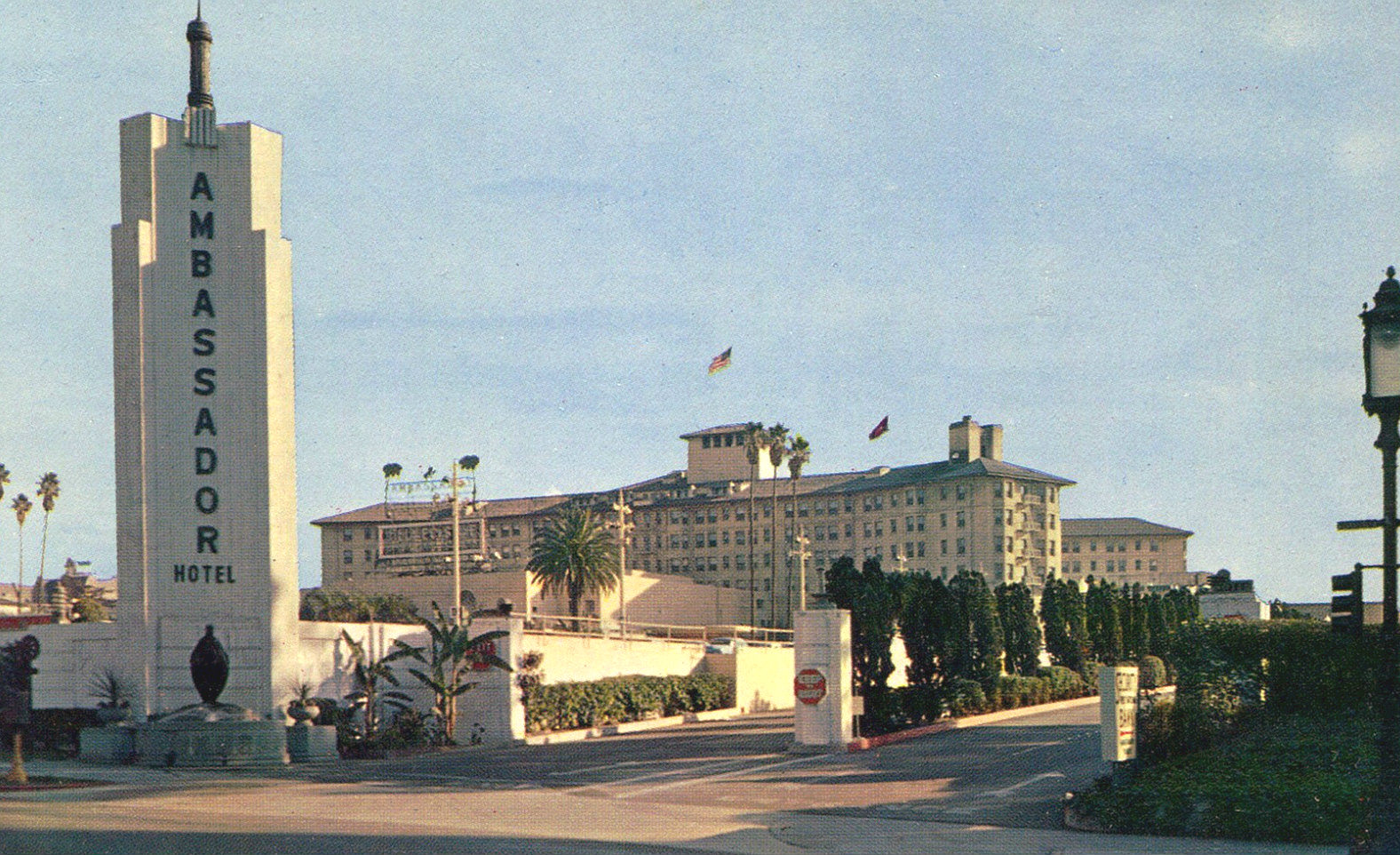
Ambassador Hotel (Los Angeles)

The Ambassador Hotel (Los Angeles), with over 1,000 guest rooms, opened at the stroke of midnight on January 1, 1921, occupying 23.7 acres on Wilshire Boulevard.  It was, until 1968, most famous for its Cocoanut Grove night club where for decades the biggest stars in show business performed—Frank Sinatra, Judy Garland, Martin & Lewis, Diana Ross & the Supremes, Barbra Streisand, Benny Goodman, Dizzy Gillespie, Nat King Cole, Bing Crosby, and many, many more.  And the biggest names in show business were in the audience, including Marilyn Monroe, Louis B. Mayer, John Wayne, Henry Fonda, Katharine Hepburn and Spencer Tracy, Cary Grant, Clark Gable, Joan Crawford, and Carole Lombard.  Crawford and Lombard frequently competed (friendly competition?) in dancing the Charleston there.  And between 1930 and 1943, the Cocoanut Grove played host to six Academy Awards ceremonies.

But then on the night of June 5, 1968, Senator Robert F. Kennedy of New York won the California primary election for the Democratic Party's presidential nomination.  He gave his victory speech at the hotel, which everyone assumed was a dress rehearsal for what would be his nomination acceptance speech in August at the Democratic Party convention in Chicago.  Instead, while leaving the hotel through the kitchen, Senator Kennedy was shot and killed.

The hotel went into a slow decline and was finally demolished in 2006 after a lengthy legal bout with preservationists led by Diane Keaton.  The property is now part of the Los Angeles Unified School District.  The District built a spacious six-story building on the site with a design that pays tribute to the design of the Ambassador Hotel.  Six separate charter K-12 schools were installed there, one on each floor of the building, drawing students from within a 10-block radius of the campus. The schools were named the Robert F. Kennedy Community Schools.
🌎🌎🌎
North by Northwest was nominated for three Academy Awards and ranks at number 55 on the American Film Institute's and number 53 on the British Film Institute's lists of 100 greatest films.

🌎🌎🌎

Current imdb fans rank: #110.

C: Robert Burks   D: Alfred Hitchcock


Monday, June 1, 2020

Screenshot for the Week of 1 June 2020: "WEST SIDE STORY" (1961)


Tony Mordente, George Chakiris, and an unknown dancer in West Side Story (1961)


A gang of white New York street thugs think they're entitled to "own" a few square blocks in their west side neighborhood. But a Puerto Rican gang of street thugs has moved in.

What could go wrong?  It doesn't take long for them to break into song.  Why can't we all get along?

🌎  🌎  🌎

West Side Story has taken its knocks over the past twenty years.  Everyone already knew that Natalie Wood hadn't done her own singing, that Marni Nixon had dubbed her singing voice.  But many fans of the movie were disappointed and somewhat shocked by the news (revealed in background features on the 2003 DVD release) that all the of leading actors' singing voices had been dubbed.  Tony?  Not Tony!  Yes, Tony too.  Not Riff!  He sounds just like Riff!  Yeah, Riff too.

Also, the movie has been called to account for using white actors to play the Puerto Rican roles.  This criticism is especially relevant now because a new version of West Side Story, directed by Steven Spielberg, to be released this Christmas, will feature Puerto Ricans in the Puerto Rican roles.
🌎🌎🌎
West Side Story was the first serious movie I saw at the theater.  It was the film that most influenced me as a moviegoer as I was growing up.  Yet even in January 1962 when I saw it at the age of 7, I was not comfortable with white actors wearing heavy brown makeup and using phony accents to play Puerto Ricans.  I must admit, however, that I only spotted a few of these phonies back then.

I'm glad I saw West Side Story with my sisters and before I learned I wasn't supposed to like musicals.  Thanks to this movie and The Wizard of Oz (1939), I unwittingly paved my way to enjoying The Sound of Music (1965), Damn Yankees! (1958), Fiddler on the Roof (1971), My Fair Lady (1964), the Astaire-Rogers dance musicals, La La Land (2016), the Broadway show Les MisΓ¨rables, and many others.

🌎🌎🌎

Most Hollywood musicals were produced before the advent of the widescreen movie in 1953.  They can be fully enjoyed at home even on a smallish TV monitor (e.g., 42" diagonal).  However, West Side Story—shot on location in New York City in 70mm with a cut 2.35:1 aspect ratio—can be fully appreciated only on the big screen in a movie theater.  I don't want to talk you out of watching the movie at home.  By any means necessary see this film, please see it.  However, though not shot in 3D, West Side Story is very nearly 3-dimensional during the dance sequences.  The dance numbers take up a lot of 3rd-dimension space on those New York City streets, the rooftop, and the playground.  Oddly enough, this depth of field is visually enhanced by the big screen.  If you ever get the chance to see it on the big screen, take it.
🌎🌎🌎
Most of the players in West Side Story were professional dancers.  Many had worked with choreographer Jerome Robbins in the Broadway production of the musical, which Robbins had staged.  For the film he would direct the dancing and singing scenes for which he earned the credit of co-Director.  Producer and co-Director Robert Wise would direct the drama scenes.

Robbins worked his dancers rigorously during rehearsals, but his choreography was so exacting and thrilling that he garnered a lifetime's worth of respect and allegiance from those dancers.

The intense rehearsals paid off.  Jerome Robbins and Robert Wise developed "creative differences" during the filming, and Wise, as producer, fired Robbins.  The leading dancer then took over supervision of Robbins's choreography for the rest of the filming.  As of the 2011 release of the restored version of the movie on Blu-ray and DVD, the dancers and the leading actors as well still had hard feelings over Robbins's dismissal.
🌎🌎🌎
West Side Story was nominated for eleven Academy Awards and won ten of them.  Best Director Oscars went to Robert Wise and Jerome Robbins.  This was the first time two Oscars were given for Outstanding Direction.
🌎🌎🌎
The movie played for 249 consecutive weeks in Paris, the longest theatrical movie run in French history.

C: Daniel Fapp.  D: Jerome Robbins and Robert Wise.

Screenshot of the Month: "L.A. Confidential" (1997)

Russell Crowe ("Officer Bud White") dangling  Ron Rifkin ("District Attorney Ellis Loew") out an L.A.P.D. upper  floor o...