Showing posts with label Alfred Hitchcock. Show all posts

Sunday, February 28, 2021

Screenshot for a Fortnight: "REAR WINDOW" (1954) (01 March to 14 March 2021)

James Stewart in Rear Window (1954)

[SPOILER ALERT!] A man who makes his living closely observing the world as a photographer finds himself wheelchair-bound in his apartment with nothing better to keep boredom away than voyeurism.  With his windows and blinds open, he trains his eyes and ears on the world of his neighbors—the composer, the couple with the dog, Miss Lonelyhearts, Miss Torso, the salesman and his wife, the artist, and the newlyweds.  What he sees and hears leads him to conclude that one of those neighbors is a murderer. [END SPOILER ALERT]


Grace Kelly

Wendell Corey


Kelly and Stewart

Thelma Ritter and Stewart

 
Rear Window (1954) is based on a story by Cornell Woolrich entitled "It Had to Be Murder," which in turn is based on an H.G. Wells story, "Through a Window."  

Woolrich was a prolific noir fiction writer, publishing dozens of novels and hundreds of stories during his long career.  He garnered early success in his hometown of New York writing and publishing six jazz age novels between 1926 and 1932.  After winning a $10,000 writing contest sponsored by First National Pictures he abruptly took a job at First National in Hollywood writing screenplays, or trying to write them.  Within two years he returned to New York and began to write pulp noir fiction.

Despite accumulating wealth as a writer, he lived with his mother for 25 years in a series of seedy hotels, mingling with prostitutes, thieves, killers, and other lowlifes.  From the time of his mother's death in 1957 until his own death in 1968, however, he lived in more civilized lodgings on the upper west side and mingled with his colleagues and young admirers in the unofficial New York hangouts of the Mystery Writers of America.

Alfred Hitchcock and James Stewart formed a partnership in 1953 and bought the rights to "It Had to Be Murder" to make this film.

🌎  🌎  🌎

John Michael Hayes was Alfred Hitchcock's favorite screenwriter, until he wasn't.  Rear Window was their first film together.

The Woolrich story has no romantic subplot, and Jeff's disability isn't revealed until the last paragraph.  Hayes made these two storylines prominent in his screenplay.

He also took this dialogue from "It Had to Be Murder"—  

Did any of them see her leave, according to your man? …  Then all you've gotten is a second-hand version of an unsupported statement by him.  Not an eyewitness account.

—and turned it into this:

Well, what good's his information?  It's a second-hand version of an unsupported story by the murderer himself—Thorwald.  Now, did anybody actually see the wife get on the train?

He took the insipid character of Sam in Woolrich's story and created a funny and insightful replacement, Stella, the insurance company nurse.  He then split the sounding-board duties between Stella and Jeff's romantic partner played by Grace Kelly.

Hayes continued his successful collaboration with Hitchcock on To Catch a Thief (1955), The Trouble with Harry (1955), and The Man Who Knew Too Much (1956).  But something fell apart between them after Hayes had written The Man Who Knew Too Much, and Hitchcock decided to leave Hayes's name off the credits and give another writer, Angus MacPhail—who had contributed some minor help early on—full credit for the screenplay.  Hayes took Hitchcock to arbitration, won his case, and his name replaced MacPhail's as the sole screenwriter.  Thus Hayes's relationship with Alfred Hitchcock came to a bitter end.

🌎  🌎  🌎 

Rear Window was one of the "Five Lost Hitchcocks," so-called, because after their theatrical releases the director bought back each movie's rights.  For three decades the films were tied up, first by Hitchcockian fiat and then, after his death, by litigation over re-distribution rights.  The other four films were Rope (1948), The Trouble with Harry (1955), The Man Who Knew Too Much (1956), and Vertigo (1958).  They all became available for re-distribution in 1984.

🌎  🌎  🌎

The film was shot on an enormous set at Paramount Pictures built specially for Rear Window.  It took fifty workers two months to build it at a cost of $100,000 ($2.2 million in 2023).  It was four stories high and contained thirty-one apartments, including twelve that were fully furnished.  Georgine Darcy—"Miss Torso"—lived in her character's apartment during the filming.

The courtyard was constructed in what had been the studio basement before a crew excavated and prepped it for this movie.  Jeff's second-story apartment was actually on street level in the real world.

The set was a legend in its own time and was the object of an unusually high number of visitors to a Hitchcock set as well as the object of photo spreads in several magazines, including LIFE, while the movie was being shot.  Hitchcock kept his base of operations inside Jeff's apartment throughout the filming, and he communicated with the actors in the other apartments via radio-frequency transmission to earpieces they wore.

🌎  🌎  🌎

Rear Window was nominated for four Academy Awards: Best Director, Screenplay, Cinematography, and Sound.  It ranks at number 48 on the American Film Institute's list of 100 Greatest Films, number 53 on the British Film Institute's 2012 list of the 100 Greatest Films, and number 8 on My 25 Favorite Movies list.  Current imdb fans rank #58/250


Monday, February 15, 2021

Screenshot for the Week of 15 February 2021: "NOTORIOUS" (1946)

Secret agent Devlin (Cary Grant), looking at a hungover Alicia Huberman (Ingrid Bergman) as she looks at him from her bed in Notorious (1946).

Alfred Hitchcock's Notorious (1946) has a lot to keep your interest—Cary Grant, Ingrid Bergman, espionage, Nazi villains, suspense, intrigue, romance, plus excellent camerawork.  What's missing from Mr. Hitchcock's usual bag of tricks is humor.  This is not a criticism.  I simply enjoy Hitchcock's sense of humor, and I miss it when it isn't there.

🌎  🌎  🌎

Pretty-boy actors, like beautiful female actors, have always had the burden of proof.  Do they have acting talent or are they just pretty faces?

Early in his career, Cary Grant wasn't given much to work with.  In most of those roles he was just a pretty face.  From This Is the Night (1932) through The Toast of New York (1937), with one exception, he delivered one mailed-in performance after another.  The exception was Sylvia Scarlet (1935) with Katharine Hepburn, the first of their four pairings.  Under the direction of George Cukor, Grant received excellent reviews for his performance, and he always considered Sylvia Scarlet the breakthrough of his career.

He broadened his comic chops with notable performances in The Awful Truth (1937); Bringing Up Baby (1938), pairing him again with Katharine Hepburn; Holiday (1938), again playing opposite Katharine Hepburn; His Girl Friday (1940); My Favorite Wife (1940); and The Philadelphia Story (1940), yet another pairing with Katharine Hepburn.

It might surprise you to know that after 1934, Cary Grant was a freelancer, not under a long-term contract with any studio, free to make one-picture deals with the highest bidder.  And oh, the bidding was high.  He went from $750 a week to $2,500 a week virtually overnight.  By 1937 he was earning $50,000 per picture plus 10% of the gross.  By The Bishop's Wife (1947), he was earning $500,000 per picture.

🌎  🌎  🌎

I'm incredulous that Ted Tetzlaff was given the title of Director of Photography on Notorious.  It's incredible because most of Hitchcock's cinematographers got their credits as cinematographers, not DoPs.  On most of his movies, Hitchcock was his own uncredited DoP.  I don't know which of them was responsible for the camera positioning for that screenshot of Cary Grant up there.  

Tetzlaff also shot My Man Godfrey (1936), Road to Zanzibar (1941), and I Married a Witch (1942).  He had been working his craft for twenty years before Notorious, and had gotten the more prestigious title of DoP only 15 times in 114 films.  He was nominated for one Oscar in his 33-year career.

Tetzlaff and Hitch had a hitch of their own when Hitchcock told Tetzlaff to film Ingrid Bergman and Cary Grant with a light aimed at the backs of their necks as the motorcycle cop is supposedly pulling them over.  Irritated, Tetzlaff said, "Getting a bit technical, aren't you, Pop?"  Perhaps it was only a coincidence: Tetzlaff retired from camerawork after Notorious and switched to directing.

[SPOILER ALERT!] Hitchcock was the first filmmaker to see the Nazi threat for what it was and to do something about it.  His guerilla war against the Nazis via film was the mainstay of his work from 1935 through 1946.  He went after them in The 39 Steps (1935), well before the start of World War II, although he took great pains not to identify the "enemy."  His war continued with The Lady Vanishes (1938) and arguably Sabotage (1936).  After Germany invaded Poland, and England entered the war, he continued his guerilla attacks with Foreign Correspondent (1940), Saboteur (1942), and Lifeboat (1944).  And now, in 1946, with Hitler dead and Germany defeated and occupied by the allied countries, Hitchcock is chasing the fleeing Nazis to South America.

[SPOILER ALERT!] Ingrid Bergman's native country, Sweden, was famously neutral on the world stage and had been so since the 19th Century.  This policy of neutrality continued through both World War I and World War II and is still its policy.  Between the wars Sweden was a strong supporter of the League of Nations and devoted its energies to preserving the League rather than building its military.  Throughout WWII it provided some assistance to both sides, although to my eyes Sweden seemed to favor the allies.  And in 1942 it quickly began to rebuild its military and armaments to deter a possible Nazi invasion.

[SPOILER ALERT!] I think two things in the Notorious moviegoer's consciousness would have made Ingrid Bergman in the role of Alicia Huberman instantly credible: Bergman's Swedish background in light of her country's legendary neutrality; and the memory of her performance in Casablanca (1942) as Ilsa Lund, a Swede married to the world famous Nazi-fighter Victor Lazslo. [END OF SPOILER ALERT!]

Ingrid Bergman made her Hollywood film debut in 1939 with the remake of a 1936 Swedish film, Intermezzo.  By the time she began work on Notorious, she had already worked with some of the greatest actors in the movies—Humphrey Bogart, Gary Cooper, Leslie Howard, Spencer Tracy, and Charles Boyer.

The verb "to gaslight" is a term used by psychiatrists and psychologists to describe the actions of a person or entity engaging in an elaborate, insidious, consistent, and relentless campaign of deception and psychological manipulation, usually against one victim, for the purpose of increasing the gaslighter's power over the victim by convincing the victim that his or her vision of reality is 180 degrees off.  Ultimately, this campaign, if unchecked, renders the victim pathologically dependent on the gaslighter and on his thinking and feelings.

When "gaslighting" broke out of its professional moorings and came into vogue a few years ago, it retained its professional definition.  But soon the verb morphed into a second definition which eliminates the pathological components and reduces it to a term that refers to repeated denials accompanied by plausible cover stories.  And because of that, I assume most users have no idea where the term originated.

As most Ingrid Bergman fans would know, even when hearing "gaslighting" for the first time, the term comes from the 1944 gothic suspense classic, Gaslight.  [SPOLIER ALERT!—FOR GASLIGHT (1944)] In it, Charles Boyer, playing the husband, slowly poisons the mind of his wife, Paula, played by Ingrid Bergman, so she can't tell what's real and what isn't.  Throughout the movie he takes advantage of every opportunity to lie and manipulate reality to make Paula think she's going crazy.

He wants her to distrust her own eyes and ears and memory to prevent her from catching on to his longstanding criminal scheme—having murdered her Aunt Alice in her home many years earlier in a thwarted jewel robbery, having set up his encountering Paula for the first time, having maneuvered to marry her, and having maneuvered to move into her aunt's old house, he now rummages in the attic to find the precious jewels for which he had killed so long ago.  Among many other shenanigans, he tells Paula she's imagining the gas lamp dim and re-illuminate by itself—am I crazy? or is the ghost of Aunt Alice doing it?—when in actuality it dims when he turns a gas lamp on in the attic and re-illuminates when he turns it off.  Bergman won the Oscar for Best Actress for her performance in this film. [END OF GASLIGHT SPOILER ALERT!]

🌎🌎🌎

David O. Selznick was a Hollywood legend, wunderkind, and ogre.  As a wunderkind he produced dozens of films for M.G.M. from 1928 to 1932 and gained the notice and favor of the boss, Louis B. Mayer, as well as the hand in marriage of the boss's daughter, Irene, in 1930.  As a wedding gift, Irene's father paid for the custom-building of a Beverly Hills mansion.  The Selznicks divorced in 1948.  Meanwhile, Selznick's star in the movie business continued to rise.  He moved to Paramount and then R.K.O. where he became head of production and produced King Kong (1933) among many other films.  He then returned to M.G.M. where his father-in-law gave him his own production unit.  With it he produced Dinner at Eight (1933), Manhattan Melodrama (1934), David Copperfield (1935), Anna Karenina (1935), and Reckless (1935).  Finally in 1936 he leased a corner of the Culver Studios backlot and formed Selznick International Pictures.  His meteoric rise and his productions of A Star Is Born (1937), Nothing Sacred (1937), Intermezzo (1939), Gone with the Wind (1939), and Rebecca (1940) stand as testaments to his talent and his ambition.

The opening title says Alfred Hitchcock's Notorious is "[b]y arrangement with David O. Selznick."  Selznick had contracted the key components of what would become Notorious—director Alfred Hitchcock, actors Cary Grant and Ingrid Bergman, and writer Ben Hecht.  He sold the rights to the project to R.K.O. Studios for $800,000 and 50% of the profits so he could fund his own pet project, Duel in the Sun (1946), starring Gregory Peck and the next Mrs. Selznick, the ravishing Jennifer Jones.

🌎   ðŸŒŽ  ðŸŒŽ

Notorious is part of The Criterion Collection (#137).


Sunday, November 22, 2020

Screenshot for the Week of 23 November 2020: "NORTH BY NORTHWEST" (1959)

Cary Grant, Eva Marie Saint, James Mason, and Martin Landau in North By Northwest (1959).  C: Robert Burks.  D: Alfred Hitchcock.

Alfred Hitchcock is my favorite director, and North by Northwest is my favorite Hitchcock film.  It is #3 on my list of all-time favorite films, just behind Casablanca (1942) and Chinatown (1974).  Six of Hitchcock's films are in my top 101, and three are in my top 25.  (Rear Window [1954] is #8 and The 39 Steps [1935] is #18.)(Macreedy is my imdb handle.)

🌎🌎🌎

Robert Burks photographed eleven of Hitchcock's films, beginning with Strangers on a Train (1951) and ending with The Birds (1963), although he didn't work on every Hitchcock film in that period.  While Hitchcock occasionally worked with other cinematographers, Burks worked with other directors as well.  He shot Hondo (1953) for John Farrow, The Vagabond King (1956) for Michael Curtiz, The Spirit of St. Louis (1957) for Billy Wilder, and The Music Man (1962) for Morton DaCosta.  Burks was nominated for an Oscar four times and won for To Catch a Thief (1955).

🌎🌎🌎

Screenwriter Ernest Lehman is one of the greatest screenwriters almost no one has ever heard of.  But you've heard of the movies he has written or adapted for the screen: Sabrina (1954), The King and I (1956), Somebody Up There Likes Me (1956), Sweet Smell of Success (1957), North by Northwest, West Side Story (1961), The Sound of Music (1965), and Who's Afraid of Virginia Woolf? (1966), among others.

Censors poured over North by Northwest, especially the script.  They forced a change in the dialogue in the scene on the train with Roger Thornhill (Cary Grant) and Eve Kendell (Eva Marie Saint).  Kendell says in the original script, "I never make love on an empty stomach."  To appease censors, Lehman changed it to "I never discuss love on an empty stomach."  When you watch the movie, watch Eva Marie Saint's lips when she delivers her line.  Hitchcock simply looped her new line in and didn't reshoot the scene.  You can see her clearly say "make love" while you hear "discuss love."

The censors were hesitant to allow the character Leonard (Martin Landau) to even appear to be possibly gay, and they wouldn't allow the script to take it further.  During filming, however, Lehman added a line for Leonard that wasn't in the script censors reviewed: "Call it my woman's intuition."  It slipped through the censor's net.  And they didn't catch the symbolism of the train entering the tunnel at the end of the movie either.

🌎🌎🌎

Cary Grant was the ideal actor to play Roger Thornhill.  William Holden was briefly considered but never offered the job.  If you think about it, had Grant not been available, Hitchcock could've made this movie with Holden as Thornhill and not lost much, if anything, in the characterization.

Hitchcock filmed one scene at the Plaza Hotel, the one where Thornhill walks into the hotel and down a corridor toward the "Oak Bar" (a common, unofficial nickname for the Oak Room).  They didn't film inside the Oak Room itself but at MGM Studios in Culver City where an exact replica of the Oak Room was painstakingly built.  In fact, all the shooting inside the Plaza Hotel was done with one take.  Grant walked into the hotel, down the corridor, turned the corner, and went straight to the room that MGM had provided him at the Plaza, which he had insisted on as part of his deal.  He was done for the day.

🌎🌎🌎

Ambassador Hotel, Chicago

In North by Northwest, on the way to their destinies, Van Dam and company stay at the Ambassador East (now Ambassador Chicago), which opened in Chicago in 1926.

Ambassador, New York

The Ambassadors were a chain of luxury hotels, the first having been opened in Atlantic City in 1919.  The Ambassador New York on Park Avenue opened in 1921.  Like the other Ambassadors, it was a hotbed of top flight entertainment.


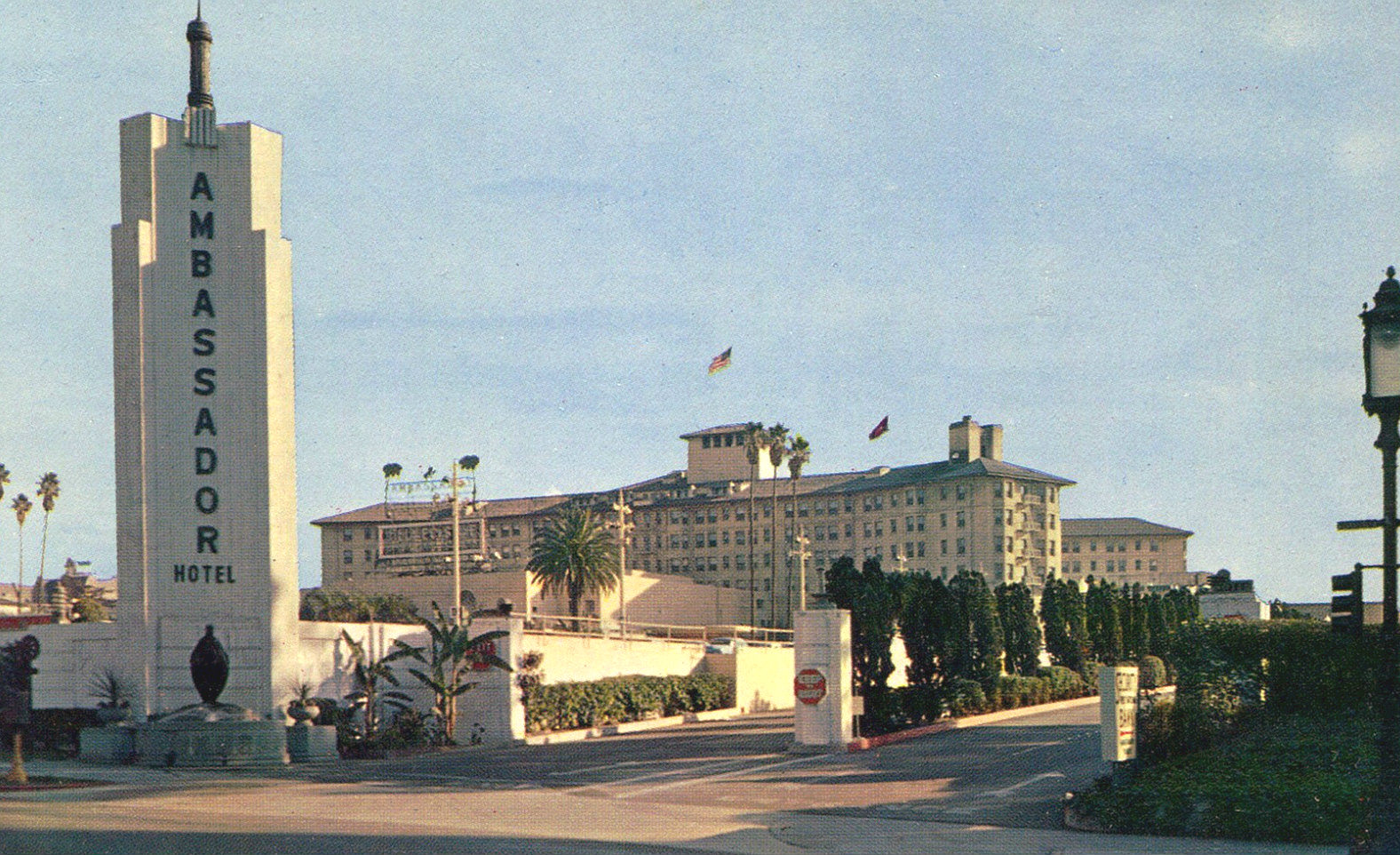
Ambassador Hotel (Los Angeles)

The Ambassador Hotel (Los Angeles), with over 1,000 guest rooms, opened at the stroke of midnight on January 1, 1921, occupying 23.7 acres on Wilshire Boulevard.  It was, until 1968, most famous for its Cocoanut Grove night club where for decades the biggest stars in show business performed—Frank Sinatra, Judy Garland, Martin & Lewis, Diana Ross & the Supremes, Barbra Streisand, Benny Goodman, Dizzy Gillespie, Nat King Cole, Bing Crosby, and many, many more.  And the biggest names in show business were in the audience, including Marilyn Monroe, Louis B. Mayer, John Wayne, Henry Fonda, Katharine Hepburn and Spencer Tracy, Cary Grant, Clark Gable, Joan Crawford, and Carole Lombard.  Crawford and Lombard frequently competed (friendly competition?) in dancing the Charleston there.  And between 1930 and 1943, the Cocoanut Grove played host to six Academy Awards ceremonies.

But then on the night of June 5, 1968, Senator Robert F. Kennedy of New York won the California primary election for the Democratic Party's presidential nomination.  He gave his victory speech at the hotel, which everyone assumed was a dress rehearsal for what would be his nomination acceptance speech in August at the Democratic Party convention in Chicago.  Instead, while leaving the hotel through the kitchen, Senator Kennedy was shot and killed.

The hotel went into a slow decline and was finally demolished in 2006 after a lengthy legal bout with preservationists led by Diane Keaton.  The property is now part of the Los Angeles Unified School District.  The District built a spacious six-story building on the site with a design that pays tribute to the design of the Ambassador Hotel.  Six separate charter K-12 schools were installed there, one on each floor of the building, drawing students from within a 10-block radius of the campus. The schools were named the Robert F. Kennedy Community Schools.
🌎🌎🌎
North by Northwest was nominated for three Academy Awards and ranks at number 55 on the American Film Institute's and number 53 on the British Film Institute's lists of 100 greatest films.

🌎🌎🌎

Current imdb fans rank: #110.

C: Robert Burks   D: Alfred Hitchcock


Tuesday, August 18, 2020

Screenshot for the Week of 17 August 2020: "TO CATCH A THIEF" (1955)


Cary Grant and Grace Kelly in To Catch a Thief (1955)

Alfred Hitchcock had his "A" team on this movie—his favorite actor, Cary Grant; favorite actress, Grace Kelly; favorite assistant director/second-unit director, Herb Coleman; favorite screenwriter, John Michael Hayes; favorite cinematographer, Robert Burks; favorite film editor, George Tomasini; favorite costume designer, Edith Head; plus the best process photographer in the business, Farciot Edouart, shooting French Riviera rear-projection film for Grace Kelly's driving scenes.  So why is To Catch a Thief only a so-so movie?

Why?  Because unlike Rear Window and The Man Who Knew Too Much, nothing has been added to the plot of To Catch a Thief to make resolution of the mystery urgent.  And so the movie is in no hurry.

[SPOILER ALERT] In Rear Window, Jeff and his deputies Lisa and Stella have to investigate and solve the crime before Thorwald flees the city, which could happen at any time.  There's a real sense of urgency.  And in The Man Who Knew Too Much, what could be more urgent than stopping the assassination of a prime minister and rescuing a kidnapped child? [End SPOILER ALERT]

💎💎💎

(More to come.)

C: Robert Burks.  D: Alfred Hitchcock.


Monday, June 15, 2020

Screenshot for the Week of 15 June 2020: "SABOTEUR" (1942)


Pat Martin and Barry Kane (Priscilla Lane and Robert Cummings) walk toward the office buildings at a mine in Saboteur (1942).


[SPOILER ALERT!] The two characters in this screenshot eventually look through a telescope aimed out a window in one of those buildings and they see Hoover Dam, which puts their location in Nevada or Arizona.  But in fact, this scene was filmed in the Owens Valley in eastern California, and, alas, Hoover Dam isn't visible from there. [END OF SPOILER ALERT!]

The actors are in Keeler, California, walking toward an actual borax mining operation that is still there and in operation more than 80 years later.  In the background we see the eastern slope of the Sierra Nevada.  In between is a dry lake bed, the former Owens Lake.  To the right but out of the frame are the Owens Valley towns of Lone Pine, Independence, Big Pine, and Bishop.  Behind the camera, about 90 miles away, is the town of Furnace Creek in what was then Death Valley National Monument and is now Death Valley National Park.


Owens Lake(dry) and the eastern Sierra Nevada seen from Keeler, California, 10 miles east of the town of Lone Pine.  Photo by Bookman, November 2011.

Toward the end of 1904, three strangers showed up in the Owens Valley.  They found themselves in a modern day Garden of Eden, naturally irrigated by the Owens River watershed, with the river itself emptying into Owens Lake.  It was a burgeoning produce-growing region with the hope of an explosion of demand, once the Santa Fe built the expected railroad spur to San Bernardino, connecting Bishop to the restaurants and grocery stores of Los Angeles.  Owens Valley farmers had every reason to believe that the people of L. A. would make them rich.

Fred Eaton, William Mulholland, and Joseph Lippincott, with malice aforethought, introduced themselves as neophyte ranchers looking to buy property in the area.  In truth, Eaton was the head of the L. A. Department of Water and Power (DWP), Mulholland was its chief engineer, and Lippincott was its land agent.  L. A. was growing, and it didn't have its own natural water supply.  It was a veritable desert.  It was thirsty and getting thirstier.

The three strangers had come to buy property, all right—hundreds of square miles of it, one seller at a time and, usually, one parcel at a time, not telling anyone about the other land purchases as they moved from one transaction to the next.  The DWP representatives wanted "riparian" land, i.e., land that bordered the Owens River.  Ultimately, they were there to snatch the farmers' entire water supply and to do it before anyone caught wind of their scheme. They were going to leave the Owens Valley to dry up and wither economically.  They were going to leave it for dead.

Lippincott orchestrated the DWP chicanery, using smooth-talking Eaton as his front man. Within weeks, DWP had bought most of the land in the Owens Valley.  Six days after Lippincott had finished his work, a syndicate of investors that included Eaton and Mulholland and the publishers of every L. A. newspaper but one paid $50,000 on an option to buy the greater part of another valley, the San Fernando Valley.

It all began when Mulholland devised an ambitious, ingenious plan.  It hinged on a surreptitious DWP land grab, airtight secrecy via a news lockdown, and L. A.'s incorporation of the San Fernando Valley into the City.

Fred Eaton was looking for a new and steady supply of water for L. A. even before the company he owned—the Los Angeles Water Company—became DWP, a public utility.  He and William Mulholland zeroed in on the Owens River and Owens Lake.  Mulholland's survey work had revealed that gravity could take water from the Owens River all the way to the Tehachapi Mountains, at which point pumps could take the water over the Tehachapis to its ultimate destination.

Reservoirs would be needed for water storage, and the San Fernando Valley, though not within the City limits, was the ideal location for the largest one.  The City could annex the Valley, build the reservoirs, purchase all the water rights in the Owens Valley, build a 224-mile-long aqueduct and have it all paid for by voter-approved bonds (the conspirators had a nasty plan for gaining approval).  It would eventually bring manna in the form of water to the lucky future landowners in the Valley.

Even luckier would be those buyers who bought land in the San Fernando Valley while the Valley was still an arid desert, while land prices were low, before the news broke that water was on the way, news that would cause property values to skyrocket.

It was only after this coordinated plan was agreed to by all the conspirators that Eaton dispatched himself and Lippincott to the Owens Valley with the task of buying as much land there as they could.  They were so successful that all the riparian land along the Owens River plus Owens Lake plus the land underneath all the towns and cities in the Owens Valley have been owned by the City of Los Angeles for more than a century.

Construction on the aqueduct began in 1908 and was completed in 1914.  For the next decade, Owens Valley farmers rebelled by periodically blowing up sections of the aqueduct with dynamite.  The City of Los Angeles sent a private militia to guard the length of the aqueduct with shoot-to-kill orders.  The hostile events of this era are known collectively as the California Water Wars.

Some of the elements of this saga contributed to the plot of Chinatown (1974), with Jack Nicholson, Faye Dunaway, and John Huston.

Owens Lake was already dry by the time Hitchcock filmed part of Saboteur there.  In fact, L.A.'s spectacular population growth required it to extend the aqueduct twice, eventually to the feeder streams of Mono Lake, 125 miles north of Owens Lake.  The draining of Mono Lake has been but another chapter in the history of the California Water Wars.

C: Joseph Valentine.  D: Alfred Hitchcock.

Sunday, June 7, 2020

Screenshot for the Week of 08 June 2020: "VERTIGO" (1958)


Madeleine (Kim Novak) under San Francisco's Golden Gate Bridge in Vertigo (1958).


A cop who's afraid of heights. A gorgeous woman who looks a lot like Kim Novak. A semi-handsome Gal Friday. A semi-stranger from the past. And reality is as slippery as seaweed in San Francisco Bay.

🌎 🌎 🌎


"Golden Gate" isn't just shorthand for the Golden Gate Bridge. The Golden Gate is a strait between the San Francisco headlands and the Marin headlands. It's the waterway that connects San Francisco Bay and the Pacific Ocean. The bridge spans the Golden Gate from one side to the other. Explorer John C. Frémont gave the strait its name in 1846, referring to a golden gate for more trade with China. This was two years before the discovery of gold in California and nine decades before the bridge was built.


🌎🌎🌎

We no longer have the view of the Golden Gate that we see in this screenshot. We lost it immediately after the September 11 attacks. [Spoiler Alert!] The large area that envelopes the south end of the bridge, including the spot where Madeleine stands, has been off limits ever since. In short, today Madeleine would have to jump into the Bay about two hundred feet behind where the cameraman stood.[End of Spoiler!]

🌎🌎🌎

Vertigo offers a lot to look at. Every scene is a visual feast. I had to see the movie several times before I could take my eyes off of the key characters and focus all of my attention on the background. I'm familiar with San Francisco, and I wanted to see it in the movie.


Vertigo shows off the City and County of San Francisco better than any other movie. The scene in the screenshot was filmed at Fort Point, an armory that predates the Civil War and is now a National Historic Site.

Ernie's restaurant in North Beach, where Scottie first sees Madeleine, was a fixture on Columbus Avenue, and continued in business until the 1990s. (Its interior was recreated in painstaking detail in a sound studio for actual filming.)

Lombard Street, the "crookedest street in the world" that Scottie drives to get home, is still there, as is Scottie's apartment building on Lombard Street.

Until about 10-15 years ago, the exterior of Scottie's apartment hadn't changed noticeably since the film was shot. When I last drove past it the door was still painted blood orange. But I saw it on Google Maps streetview a few years ago. The façade had had an extreme makeover. Scottie's apartment was unrecognizable. For me, it was gone.


The McKittrick Hotel, like its elusive guest Carlotta Valdes, is long gone. So are Podesta Baldacci (florist shop) and Ransohoff's (dress shop).


But Union Square is still there. So is Coit Tower, in the distant background on Telegraph Hill, seen from inside and outside Scottie's apartment. So are Argosy Books (Pop's book shop), Mission Dolores and its cemetery, Mission San Juan Bautista and its stables, the Palace of the Legion of Honor, Big Basin Redwoods State Park, and Cypress Point.


Current imdb fans rank: #118.
C: Robert Burks.  D: Alfred Hitchcock.

Screenshot of the Month: "L.A. Confidential" (1997)

Russell Crowe ("Officer Bud White") dangling  Ron Rifkin ("District Attorney Ellis Loew") out an L.A.P.D. upper  floor o...