Monday, June 29, 2020

Screenshot for the Week of 29 June 2020: "THE MAGNIFICANT SEVEN" (1960)


Chris (Yul Brynner) bites the end off a cigar as he prepares to drive a hearse to Boot Hill.  Vin (Steve McQueen), riding shotgun, has just finished shaking the shot inside two shells, one shell at a time, and is now loading the shells into his shotgun in The Magnificent Seven (1960).

Mickey Rooney was a notorious scene-stealer.  (I'm going somewhere with this.)  He had various ways to snatch the audience's attention away from other actors, often by fiddling with something in his hands.  Spencer Tracy was an early victim of Rooney's, and afterward Tracy played the same trick on fellow actors for the rest of his career.

In 1960, Yul Brynner was an established film star.  He had won the Oscar for Best Actor in 1957 for his memorable performance in The King and I (1956).  Steve McQueen, on the other hand, was a relative upstart, a TV actor, which at that time was lower than a second-class citizen in the acting world.

Despite his TV popularity due to his work on the western Wanted:Dead or Alive!, McQueen was trying as a film actor to live down the infamy of his amateurish performance in the laughable horror movie, The Blob (1958).  Nevertheless, using Rooney's and Tracy's tricks, McQueen risked getting fired from The Magnificent Seven by his successful and rather obvious efforts to upstage Brynner at the beginning of this scene—shaking the shotgun shells noisily next to his right ear, one at a time; removing his hat and looking up at the second storeys and rooftops, rotating his head as if scanning while using the hat to shade his eyes.  Brynner kept up with McQueen somewhat by taking a cigar out of his pocket, biting the end off, spitting it out, and then lighting the cigar.  But he had already lost the audience.  All eyes were on McQueen.  The two actors did not get along well on set after that.

Unbeknownst to both actors, Brynner's stardom was on the wane in 1960 while McQueen's was on the rise.  Indeed, The Magnificent Seven made McQueen a legitimate movie star and the very personification of cool.

🌎🌎🌎

The Magnificent Seven (1960) is John Sturges's homage to Akira Kurosawa's Seven Samurai (1954).  [SPOILER ALERT!] In the scene that sets up the story and plot of Kurosawa's classic, an unemployed samurai moseys into a village and learns that a young girl has just been kidnapped and taken into a nearby hut.  The men of the village are afraid to intervene because the kidnapper works for a dreaded local warlord whose band of marauders have for years terrorized the village, killing peasants at will, looting their farms, and raping women.  The samurai wastes no time in walking into the hut.  We hear a brief scuffle, and the samurai walks out of the hut with the girl and no sign of the kidnapper.

[SPOILER ALERT! CONTINUES] I took the above screenshot from the parallel scene in The Magnificent Seven, which sets up a different story but in a similar plot.  In an act of racial progressiveness, Chris (Yul Brynner) and Vin (Steve McQueen) volunteer to drive a hearse to Boot Hill carrying the coffin of an Indigenous American.  A racist and armed white mob has formed at the cemetery, intending to prevent the Indigenous man's burial there. [END OF SPOILER ALERT!]

This scene is an artistic wonder.  The cinematography of Charles Lang shows the effective work of a craftsman keeping it simple and not saying, "Look at me!  I'm the cameraman!  Look at what I can do!"  The actors are comfortable in their characters.  The dialogue is brilliant in its economy.  The action is telegraphed and, for our purposes, needn't be otherwise.  This is one of my favorite scenes in a John Sturges movie.


C: Charles Lang.  D: John Sturges.

Sunday, June 21, 2020

Screenshot for the Week of 22 June 2020: "THE BIG COUNTRY" (1958)


Steve Leech and Jim McKay (Charlton Heston and Gregory Peck or their stunt doubles) fist-fighting in The Big Country (1958).

There is an art to taking a great screenshot.  Of the screenshots I have taken, this is one of my favorites.  Jim McKay has just thrown a right cross (a powerful punch) and landed it on Steve Leech's jaw.  Leech is knocked backward, falling down several frames later.  McKay's momentum while throwing this punch has bent him over like a baseball pitcher who has just thrown a 100 mph fastball.  To capture this perfect moment, I took at least half a dozen screenshots of the punch, eventually discarding all but this one.

I have seen hundreds of screenshots taken by dozens of people, and I have rarely seen any that were taken with perfection, much less art, in mind.  The overwhelming majority appear to have been taken by rote, with no discernible interest in capturing the best frame in the scene.

My best screenshots are a collaboration between me and the cinematographer.  When the cinematographer has done great work, he or she will have given me many chances to take great screenshots.  The rest is up to me.  A poorly shot movie might give me little raw material for art.  After all, I just follow the cinematographer around and shoot what he or she shot.

I can tell when I am following a master craftsman around after he or she has done stellar work.  The better the work, the more screenshots I take.  The cinematographer for The Big Country was Franz Planer.  And I took more screenshots of The Big Country than any other film thus far, 125 in all.

§    §    §

An entire filmmaking course could be taught using The Big Country alone.  It is not the only one-film filmmaking course that comes to me, but every element is masterfully accomplished.  The cinematography is first rate.  So is the art direction, indoors and out.  The musical score is rousing.  The script is a powerful allegory for the nuclear arms race of the Cold War.  The dialogue is economical.  Gregory Peck and Charlton Heston put on an acting clinic.  Heston's performance is easily his best.  There are moments when he is so good it makes the hairs on the back of my neck stand up.  William Wyler's direction is an artistic success all around.  None of the above artists, however, won an Oscar.  Burl Ives, God bless him, won the film's only Oscar, for Best Supporting Actor.  Oddly enough, I thought his performance, like that of Chuck Connors, was a bit cartoonish.  I would have nominated Charlton Heston instead of Ives.

§    §    §

[SPOILER ALERT!] The fist-fight scene is the entire film in microcosm.  The two men—one, an angry man spoiling for a fight and the other, a self-assured man of principle who fights when all peaceful alternatives have failed—trade knock down punches for so long they punch themselves to exhaustion.  When they cannot go on any longer, and both are almost prone on the ground, the principled man looks up and asks, "So tell me, Leech—what did we prove?"

C: Franz Planer.  D: William Wyler.

Monday, June 15, 2020

Screenshot for the Week of 15 June 2020: "SABOTEUR" (1942)


Pat Martin and Barry Kane (Priscilla Lane and Robert Cummings) walk toward the office buildings at a mine in Saboteur (1942).


[SPOILER ALERT!] The two characters in this screenshot eventually look through a telescope aimed out a window in one of those buildings and they see Hoover Dam, which puts their location in Nevada or Arizona.  But in fact, this scene was filmed in the Owens Valley in eastern California, and, alas, Hoover Dam isn't visible from there. [END OF SPOILER ALERT!]

The actors are in Keeler, California, walking toward an actual borax mining operation that is still there and in operation more than 80 years later.  In the background we see the eastern slope of the Sierra Nevada.  In between is a dry lake bed, the former Owens Lake.  To the right but out of the frame are the Owens Valley towns of Lone Pine, Independence, Big Pine, and Bishop.  Behind the camera, about 90 miles away, is the town of Furnace Creek in what was then Death Valley National Monument and is now Death Valley National Park.


Owens Lake(dry) and the eastern Sierra Nevada seen from Keeler, California, 10 miles east of the town of Lone Pine.  Photo by Bookman, November 2011.

Toward the end of 1904, three strangers showed up in the Owens Valley.  They found themselves in a modern day Garden of Eden, naturally irrigated by the Owens River watershed, with the river itself emptying into Owens Lake.  It was a burgeoning produce-growing region with the hope of an explosion of demand, once the Santa Fe built the expected railroad spur to San Bernardino, connecting Bishop to the restaurants and grocery stores of Los Angeles.  Owens Valley farmers had every reason to believe that the people of L. A. would make them rich.

Fred Eaton, William Mulholland, and Joseph Lippincott, with malice aforethought, introduced themselves as neophyte ranchers looking to buy property in the area.  In truth, Eaton was the head of the L. A. Department of Water and Power (DWP), Mulholland was its chief engineer, and Lippincott was its land agent.  L. A. was growing, and it didn't have its own natural water supply.  It was a veritable desert.  It was thirsty and getting thirstier.

The three strangers had come to buy property, all right—hundreds of square miles of it, one seller at a time and, usually, one parcel at a time, not telling anyone about the other land purchases as they moved from one transaction to the next.  The DWP representatives wanted "riparian" land, i.e., land that bordered the Owens River.  Ultimately, they were there to snatch the farmers' entire water supply and to do it before anyone caught wind of their scheme. They were going to leave the Owens Valley to dry up and wither economically.  They were going to leave it for dead.

Lippincott orchestrated the DWP chicanery, using smooth-talking Eaton as his front man. Within weeks, DWP had bought most of the land in the Owens Valley.  Six days after Lippincott had finished his work, a syndicate of investors that included Eaton and Mulholland and the publishers of every L. A. newspaper but one paid $50,000 on an option to buy the greater part of another valley, the San Fernando Valley.

It all began when Mulholland devised an ambitious, ingenious plan.  It hinged on a surreptitious DWP land grab, airtight secrecy via a news lockdown, and L. A.'s incorporation of the San Fernando Valley into the City.

Fred Eaton was looking for a new and steady supply of water for L. A. even before the company he owned—the Los Angeles Water Company—became DWP, a public utility.  He and William Mulholland zeroed in on the Owens River and Owens Lake.  Mulholland's survey work had revealed that gravity could take water from the Owens River all the way to the Tehachapi Mountains, at which point pumps could take the water over the Tehachapis to its ultimate destination.

Reservoirs would be needed for water storage, and the San Fernando Valley, though not within the City limits, was the ideal location for the largest one.  The City could annex the Valley, build the reservoirs, purchase all the water rights in the Owens Valley, build a 224-mile-long aqueduct and have it all paid for by voter-approved bonds (the conspirators had a nasty plan for gaining approval).  It would eventually bring manna in the form of water to the lucky future landowners in the Valley.

Even luckier would be those buyers who bought land in the San Fernando Valley while the Valley was still an arid desert, while land prices were low, before the news broke that water was on the way, news that would cause property values to skyrocket.

It was only after this coordinated plan was agreed to by all the conspirators that Eaton dispatched himself and Lippincott to the Owens Valley with the task of buying as much land there as they could.  They were so successful that all the riparian land along the Owens River plus Owens Lake plus the land underneath all the towns and cities in the Owens Valley have been owned by the City of Los Angeles for more than a century.

Construction on the aqueduct began in 1908 and was completed in 1914.  For the next decade, Owens Valley farmers rebelled by periodically blowing up sections of the aqueduct with dynamite.  The City of Los Angeles sent a private militia to guard the length of the aqueduct with shoot-to-kill orders.  The hostile events of this era are known collectively as the California Water Wars.

Some of the elements of this saga contributed to the plot of Chinatown (1974), with Jack Nicholson, Faye Dunaway, and John Huston.

Owens Lake was already dry by the time Hitchcock filmed part of Saboteur there.  In fact, L.A.'s spectacular population growth required it to extend the aqueduct twice, eventually to the feeder streams of Mono Lake, 125 miles north of Owens Lake.  The draining of Mono Lake has been but another chapter in the history of the California Water Wars.

C: Joseph Valentine.  D: Alfred Hitchcock.

Sunday, June 7, 2020

Screenshot for the Week of 08 June 2020: "VERTIGO" (1958)


Madeleine (Kim Novak) under San Francisco's Golden Gate Bridge in Vertigo (1958).


A cop who's afraid of heights. A gorgeous woman who looks a lot like Kim Novak. A semi-handsome Gal Friday. A semi-stranger from the past. And reality is as slippery as seaweed in San Francisco Bay.

🌎 🌎 🌎


"Golden Gate" isn't just shorthand for the Golden Gate Bridge. The Golden Gate is a strait between the San Francisco headlands and the Marin headlands. It's the waterway that connects San Francisco Bay and the Pacific Ocean. The bridge spans the Golden Gate from one side to the other. Explorer John C. Frémont gave the strait its name in 1846, referring to a golden gate for more trade with China. This was two years before the discovery of gold in California and nine decades before the bridge was built.


🌎🌎🌎

We no longer have the view of the Golden Gate that we see in this screenshot. We lost it immediately after the September 11 attacks. [Spoiler Alert!] The large area that envelopes the south end of the bridge, including the spot where Madeleine stands, has been off limits ever since. In short, today Madeleine would have to jump into the Bay about two hundred feet behind where the cameraman stood.[End of Spoiler!]

🌎🌎🌎

Vertigo offers a lot to look at. Every scene is a visual feast. I had to see the movie several times before I could take my eyes off of the key characters and focus all of my attention on the background. I'm familiar with San Francisco, and I wanted to see it in the movie.


Vertigo shows off the City and County of San Francisco better than any other movie. The scene in the screenshot was filmed at Fort Point, an armory that predates the Civil War and is now a National Historic Site.

Ernie's restaurant in North Beach, where Scottie first sees Madeleine, was a fixture on Columbus Avenue, and continued in business until the 1990s. (Its interior was recreated in painstaking detail in a sound studio for actual filming.)

Lombard Street, the "crookedest street in the world" that Scottie drives to get home, is still there, as is Scottie's apartment building on Lombard Street.

Until about 10-15 years ago, the exterior of Scottie's apartment hadn't changed noticeably since the film was shot. When I last drove past it the door was still painted blood orange. But I saw it on Google Maps streetview a few years ago. The façade had had an extreme makeover. Scottie's apartment was unrecognizable. For me, it was gone.


The McKittrick Hotel, like its elusive guest Carlotta Valdes, is long gone. So are Podesta Baldacci (florist shop) and Ransohoff's (dress shop).


But Union Square is still there. So is Coit Tower, in the distant background on Telegraph Hill, seen from inside and outside Scottie's apartment. So are Argosy Books (Pop's book shop), Mission Dolores and its cemetery, Mission San Juan Bautista and its stables, the Palace of the Legion of Honor, Big Basin Redwoods State Park, and Cypress Point.
C: Robert Burks.  D: Alfred Hitchcock.

Monday, June 1, 2020

Screenshot for the Week of 1 June 2020: "WEST SIDE STORY" (1961)


Tony Mordente, George Chakiris, and an unknown dancer in West Side Story (1961)


A gang of white New York street thugs think they're entitled to "own" a few square blocks in their west side neighborhood. But a Puerto Rican gang of street thugs has moved in.

What could go wrong?  It doesn't take long for them to break into song.  Why can't we all get along?

🌎  🌎  🌎

West Side Story has taken its knocks over the past twenty years.  Everyone already knew that Natalie Wood hadn't done her own singing, that Marni Nixon had dubbed her singing voice.  But many fans of the movie were disappointed and somewhat shocked by the news (revealed in background features on the 2003 DVD release) that all the of leading actors' singing voices had been dubbed.  Tony?  Not Tony!  Yes, Tony too.  Not Riff!  He sounds just like Riff!  Yeah, Riff too.

Also, the movie has been called to account for using white actors to play the Puerto Rican roles.  This criticism is especially relevant now because a new version of West Side Story, directed by Steven Spielberg, to be released this Christmas, will feature Puerto Ricans in the Puerto Rican roles.
🌎🌎🌎
West Side Story was the first serious movie I saw at the theater.  It was the film that most influenced me as a moviegoer as I was growing up.  Yet even in January 1962 when I saw it at the age of 7, I was not comfortable with white actors wearing heavy brown makeup and using phony accents to play Puerto Ricans.  I must admit, however, that I only spotted a few of these phonies back then.

I'm glad I saw West Side Story with my sisters and before I learned I wasn't supposed to like musicals.  Thanks to this movie and The Wizard of Oz (1939), I unwittingly paved my way to enjoying The Sound of Music (1965), Damn Yankees! (1958), Fiddler on the Roof (1971), My Fair Lady (1964), the Astaire-Rogers dance musicals, La La Land (2016), the Broadway show Les Misèrables, and many others.

🌎🌎🌎

Most Hollywood musicals were produced before the advent of the widescreen movie in 1953.  They can be fully enjoyed at home even on a smallish TV monitor (e.g., 42" diagonal).  However, West Side Story—shot on location in New York City in 70mm with a cut 2.35:1 aspect ratio—can be fully appreciated only on the big screen in a movie theater.  I don't want to talk you out of watching the movie at home.  By any means necessary see this film, please see it.  However, though not shot in 3D, West Side Story is very nearly 3-dimensional during the dance sequences.  The dance numbers take up a lot of 3rd-dimension space on those New York City streets, the rooftop, and the playground.  Oddly enough, this depth of field is visually enhanced by the big screen.  If you ever get the chance to see it on the big screen, take it.
🌎🌎🌎
Most of the players in West Side Story were professional dancers.  Many had worked with choreographer Jerome Robbins in the Broadway production of the musical, which Robbins had staged.  For the film he would direct the dancing and singing scenes for which he earned the credit of co-Director.  Producer and co-Director Robert Wise would direct the drama scenes.

Robbins worked his dancers rigorously during rehearsals, but his choreography was so exacting and thrilling that he garnered a lifetime's worth of respect and allegiance from those dancers.

The intense rehearsals paid off.  Jerome Robbins and Robert Wise developed "creative differences" during the filming, and Wise, as producer, fired Robbins.  The leading dancer then took over supervision of Robbins's choreography for the rest of the filming.  As of the 2011 release of the restored version of the movie on Blu-ray and DVD, the dancers and the leading actors as well still had hard feelings over Robbins's dismissal.
🌎🌎🌎
West Side Story was nominated for eleven Academy Awards and won ten of them.  Best Director Oscars went to Robert Wise and Jerome Robbins.  This was the first time two Oscars were given for Outstanding Direction.
🌎🌎🌎
The movie played for 249 consecutive weeks in Paris, the longest theatrical movie run in French history.

C: Daniel Fapp.  D: Jerome Robbins and Robert Wise.

Tuesday, May 26, 2020

Screenshot for the Week of 25 May 2020:"BAD DAY AT BLACK ROCK" (1955)

Russell Collins, Dean Jagger, and Robert Ryan in the 1955 classic, Bad Day at Black Rock. C: William Mellor. D: John Sturges.

It's September 1945, the end of WWII, and the passenger train stops in Black Rock.  Trains never stop in Black Rock, but this one does.  A stranger gets off the train.  The townspeople emerge from their complacency, grim-faced, displeased. Who is this stranger?  What does he want?  What's he digging around here for?  Before he's spoken a word, everyone in town gets nervous.

🌎🌎🌎

Is Bad Day at Black Rock (1955) simply a crime drama?  Is it film noir?  Is it a modern-day western?

This film was mostly shot about 15 miles north of the Owens Valley town of Lone Pine, California.  Production crews built the fictional town of Black Rock there for director John Sturges.  Hundreds of movies have been filmed in and around Lone Pine, mostly westerns.  Geographically it qualifies as a western.

Thematically?  One man against a handful of thugs in front of a town of cowering or indifferent citizens?  Sounds like High Plains Drifter (1973).  Sounds like High Noon (1952).  Sounds a little like The Man Who Shot Liberty Valance (1962).  Sure, there are no horses or cowboy outfits in Bad Day at Bad Rock.  And Pulp Fiction has no fedoras or Tommy guns; yet it's still a gangster film, while Some Like It Hot (1959), despite fedoras and Tommy guns, isn't.  Bad Day at Bad Rock is a modern-day western.

It is certainly a dark film—even pessimistic.  If Niagara (1953) qualifies as film noir, which it does routinely, then Bad Day at Black Rock is likewise film noir.  It's a film noir western.

Lone Pine and the remnants of "Black Rock" are situated against the backdrop of the eastern Sierra Nevada and Mount Whitney.  In the previous decade, a dark chapter in American history occurred at Manzanar, just south of the Black Rock set.  A history of Manzanar can be found here.

Bad Day at Black Rock features what was then a bold take on American history, some spectacular cinematography, and spot-on performances by everyone.  Along with the actors in the screenshot, Spencer Tracy, Walter Brennan, Lee Marvin, Ernest Borgnine, Anne Francis, and John Ericson are well-cast.

Monday, May 25, 2020

SEE YOU IN JULY!


I'm going to spend some time taking fresh screenshots. Bookman's Movie Screenshot Game will return in July 2020.

Friday, May 22, 2020

DAY 9—SECOND THURSDAY'S CORRECT MOVIE TITLES


Hooray to Fred!  He correctly identified all 80 movies in this 2-week installment!  Congratulations and well done.


1.
THE GODFATHER (1972)

2,
BLADE RUNNER (1982)

3.
GROUNDHOG DAY (1993)

4.
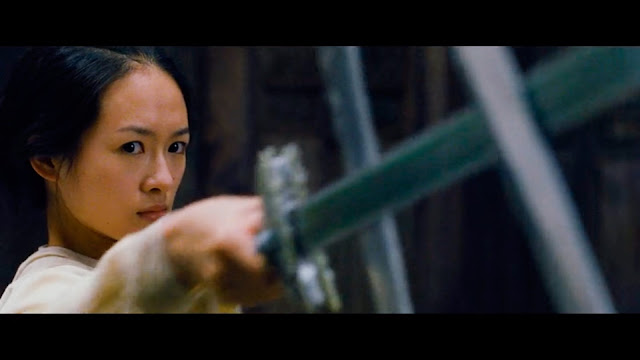
CROUCHING TIGER, HIDDEN DRAGON (2000)

5.
LA STRADA (1954)

6.
PLANET OF THE APES (1968)

7.
BACK TO THE FUTURE (1985)

8.
CLOSE ENCOUNTERS OF THE THIRD KIND (1977)

9.
FLOWER DRUM SONG (1961)

10.
THE GRAPES OF WRATH (1940)

Thursday, May 21, 2020

DAY 8—SECOND THURSDAY


Welcome to the last game of this installment.  It has been a pleasure for me to do this.

All right, you've made it to Day 8, our second dreaded Thursday Edition of Bookman's Movie Screenshot Game.  The correct titles for today's movies will post tomorrow at 12 noon U.S. Pacific Time (GMT–8).  Meanwhile, here are the correct titles for yesterday's game.


1.
LADY AND THE TRAMP (1955)

2.
BEST IN SHOW (2000)

3.
COOL HAND LUKE (1967)

4.
DIRTY DANCING (1987)

5.
DR. STRANGELOVE (1964)

6.
THE QUIET MAN (1952)

7.
ALL ABOUT EVE (1950)

8.
TO KILL A MOCKINGBIRD (1962)

9.
LIFE WITH FATHER (1947)

10.
NORTH BY NORTHWEST (1959)


AND NOW, ON TO TODAY'S BUFFER ZONE


Clark Gable and Norma Shearer in a publicity photo for
Idiot's Delight (1939)


Gloria Grahame and Humphrey Bogart in a publicity shot for the film noir In a Lonely Place (1950).


ARE YOU READY TO PLAY?

THEN LET'S PLAY!

GOOD LUCK, AND HAVE FUN!


1.


2.


3.


4.


5.


6.


7.


8.


9.


10.


Wednesday, May 20, 2020

DAY 7—SECOND WEDNESDAY


Welcome to our second Wednesday Edition of Bookman's Movie Screenshot Game.  I believe today's lineup will get you ready for tomorrow's.  I hope you enjoy it.

Meanwhile, here are the correct titles for yesterday's movies:

1.
GILDA (1946)

2.
A STREETCAR NAMED DESIRE (1951)

3.
THE SOUND OF MUSIC (1965)

4.
PLATOON (1986)

5.
TITANIC (1997)

6.
L.A. CONFIDENTIAL (1997)

7.
ROPE (1948)

8.
HIS GIRL FRIDAY (1940)

9.
MISTER ROBERTS (1955)

10.
CHARIOTS OF FIRE (1981)


AND NOW OUR BUFFER ZONE


The Phantom of the Opera (1925)


The Caine Mutiny (1954)


GOOD LUCK, AND HAVE FUN!


1.


2.


3.


4.


5.


6.


7.


8.


9.


10.


Screenshot of the Month: "L.A. Confidential" (1997)

Russell Crowe ("Officer Bud White") dangling  Ron Rifkin ("District Attorney Ellis Loew") out an L.A.P.D. upper  floor o...