Tuesday, May 11, 2021

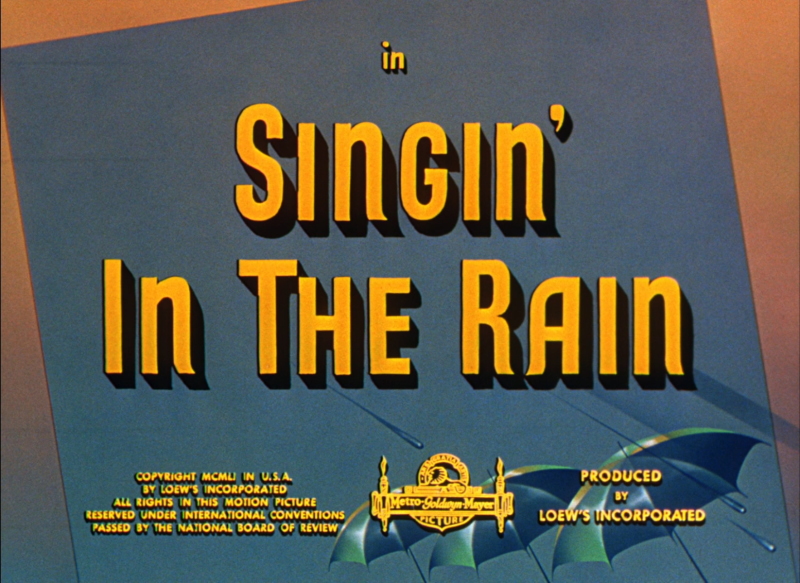
Screenshot of the Fortnight: "SINGIN' IN THE RAIN" (1952)

Donald O'Connor, Madge Blake, Gene Kelly,
and Jean Hagen in Singin' in the Rain.

Singin' in the Rain from MGM is widely considered to be the greatest movie musical of all time.  Co-directed by Stanley Donen and Gene Kelly and starring Kelly, Debbie Reynolds, and Donald O'Connor, it ranks 5th on the American Film Institute's list of the 100 greatest American films, behind Citizen Kane (1941), The Godfather (1972), Casablanca (1942), and Raging Bull (1980).  On the Sight & Sound-British Film Institute's list of the 200 greatest international films of all-time—"the only greatest movies list that most serious film critics take seriously" (Roger Ebert)—Singin' in the Rain is number 10, ahead of The Godfather (1972), The Searchers (1956), Seven Samurai (1954), Psycho (1960), Bicycle Thieves (1948), City Lights (1931), Casablanca (1942), and 83 others.

For the 1952 film year, the motion picture Academy did not even nominate Singin' in the Rain for Best Picture.  In fact, the movie received only two Oscar nominations—Best Supporting Actress (Jean Hagen) and Best Musical Score—and both nominees lost.  It was only the tenth-highest-grossing film in the U.S. and Canada and was poorly received by many critics who generally thought it was a mediocre follow-up to the previous year's Best Picture winner, An American in Paris, also an MGM musical and also starring Gene Kelly.  Not until its re-release in 1958 and Pauline Kael's review of it did Singin' in the Rain begin its rise from mediocrity to legendary status.

The Oscar race for Best Picture of 1952 was between High Noon (7 nominations) and The Bad and the Beautiful (6), with The Greatest Show on Earth (5) not seriously considered, even though it ended up winning the Oscar.  It is generally accepted that the two frontrunners canceled each other out and The Greatest Show on Earth won by default.  In its favor, the film was the highest-grossing movie in the U.S. and Canada.  On the other hand, it is telling that The Greatest Show on Earth took home 1 Oscar while The Bad and the Beautiful won 5 and High Noon won 4.

🌎   πŸŒŽ   πŸŒŽ

Gene Kelly was a taskmaster as a choreographer and a brute as a dance partner.  Cyd Charisse's husband could always tell whether she had been dancing with Kelly or Fred Astaire by the number of bruises on her body.  Though their public criticism of him was always half-joking, both Debbie Reynolds and Donald O'Connor complained to friends and family at the time that Kelly was a tyrant, overly demanding and inclined to belittle his fellow dancers in front of the rest of the cast and crew.  He reduced Debbie Reynolds to tears repeatedly.

🌎   πŸŒŽ   πŸŒŽ

The 1946 French film, Γ‰toile sans lumiΓ¨re (Star without Light) bears more than a resemblance to Singin' in the Rain.  Edith Piaf plays a hotel maid in the 1920s named  Madeleine.  A famous actress, Stella Dora, and her lover-agent, are staying at the hotel.  Dora's career is on the decline, and furthermore, she doesn't have a good enough singing voice to survive the transition from silent films to talkies.  At the hotel she is desperate and suicidal.  The agent  later overhears Madeleine singing while she is scrubbing the lobby floor and he gets an idea: he and Dora can use Madeleine's singing voice from backstage while Dora performs in front of the cameras.  Madeleine's singing becomes an overnight sensation.  But having tied Madeleine to a Faustian bargain, Dora gets all the credit.  Madeleine receives no film credits, she cannot tell anyone that her voice is in the films, and she cannot sing in public any of the songs her voice has made famous.  It was a humiliating life sentence.  In Singin' in the Rain the consequences of the dubbing are comedic and romantic.  In Star without Light they are tragic.


🌎   πŸŒŽ   πŸŒŽ


Current imdb fns rank#90/250.


Monday, April 26, 2021

Screenshot of the Fortnight: "IN THE HEAT OF THE NIGHT" (1967)

Larry Gates, Rod Steiger, and Sidney Poitier in
In the Heat of the Night.

In the 1960s in the U.S. south, Black people couldn't drink from the same water fountains as Whites.  They couldn't use the same public restrooms, sleep in the same hotels, swim in the same pools, eat in the same restaurants, or attend the same schools.

When any of them violated any racial dos or don'ts, the punishment would not be a jail sentence. It would be terror in the form of violence meted out by the Klan or the local White "citizens' council."

When, for example, a Black youth would get into a Whites-only pool, the pool would be drained and scrubbed before Whites were allowed back in.  Simultaneously, the Black youth would be tracked to his home, and he, his family, and the entire Black community would be sent a message—Black people cannot act like White people or think they are as good as Whites, and breaches of this rule will result in violence.  This message would be delivered by a burning cross on the family's front lawn, or by the family's home being burned with the family inside, or by dragging the father up and down main street, chained to the back of a pickup truck, until he became a bloody pulp.  Looking a White woman in the eye would be considered a capital offense and frequently punished by lynching. 

White "citizen councils" put a public face on Klan activity, and they included men from all walks of life, but mostly local business men and law enforcement.  Citizens' councils enforced White supremacy with terror.  Any White man or woman on the street could begin shouting at a Black man, and that man would soon be surrounded by White men, questioned loudly, accused of an offense, and then whisked away in a vehicle.

The delusional superiority of Whites was so ingrained in them and their culture, so deeply-seated, and so central to their own identities ("If you ain't better than a N_____, who are you better than?") that tens of thousands of illiterate, penniless farmboys clamored to fight against the Union in the Civil War.  These young Whites had no vested economic interest in maintaining slavery.  Their vested interest was personal, emotional, and struck at the core of who they were.  For them, and thus for the fighting itself, the Civil War wasn't about slavery, it was about the protection and enforcement of southern White supremacy and its unwritten but unmistakable codes of conduct, including total deference and submission to any White person.

White supremacy was the reason for the Ku Klux Klan, which Colonel Nathan Bedford Forrest formed after the south's defeat.  The Klan didn't go after the south's vanquisher, the U.S. government or even the north generally, seeking retribution, which it could've done with guerilla attacks on railroads and on remote military outposts.  Instead, it went after southern Blacks, to scare the populace into submission and to punish specific individuals for thinking on some level that they were entitled to the same things, the same everyday privileges, that White people had.

For nearly four hundred years, slavery was a means for slaveowners to lighten their daily physical burden of putting food on the table by "wringing their bread from the sweat of other men's faces."  But I'm convinced that the motive of maintaining slavery and slave-trading was limited to the owner class.  The masses didn't own slaves, and for them, slavery was about keeping Blacks in the lowest spot in the pecking order. For the mass of Whites, the fight was always about White supremacy.

🌎🌎🌎

In this landmark film, Philadelphia police detective Virgil Tibbs arrives in a foreign country: Mississippi, a far cry and a century and a half from modern-day Pennsylvania.  White Mississippians haven't moved beyond the antebellum era in their racial attitudes and assumptions.  One White character, looking at Tibbs wearing a nice suit, says "What you doin' wearin' White man's clothes?"  In another scene, Tibbs is dropped off at the home and car-repair business of a Black man.  The man asks Tibbs where he's staying.  Tibbs says he's going to find a hotel room.  The man laughs and turns to his wife and says "We've got company!"

There is a scene in which we see Tibbs trotting up some steps leading from the sidewalk to the entrance of a hotel.  Again he's dressed in a suit.  The scene was filmed in 1966, two years after passage of the Civil Rights Act of 1964, which outlawed racial discrimination in hotels and other places of public accommodation like restaurants, restrooms, trains, etc.  The scene was shot from across the street and a little ways down the block, and we can see the entire front of the hotel and the area near the hotel entrance.

We see Tibbs briskly mount the steps, passing two White men.  One of them looks toward Tibbs, turns and looks at his friend with incredulity on his face, and then says something to his friend that we can't hear or lipread.  His reaction to Tibbs is so realistic that it must have been real.  Perhaps the man was a local, out and about for the morning, and the production crew used him as a paid extra.  It's possible he might've said, "That was Sidney Poitier, can you believe it!"  But more likely he said something like, "Did you see that N_____  goin' in there all high and mighty like he was a White man!"

🌎🌎🌎

Sidney Poitier had been making movies and paying his dues for twenty years when he starred in In the Heat of the Night.  He landed his first credited role in 1950 as a prison doctor threatened by racist prisoners in No Way Out.  He impressed audiences and critics in 1954 as a troubled but gifted student in The Blackboard Jungle, starring Glenn Ford as one of his teachers.  He outshined his White co-star Tony Curtis in The Defiant Ones (1958).  In the film adaptation of Porgy and Bess (1959), Poitier received top billing for the first time. In 1961 he took top billing in the film adaptation of Lorraine Hansberry's Broadway classic, A Raisin in the Sun.  And he won the Oscar for Best Actor for his performance as a day laborer working for nuns in Lilies of the Field (1963).

Between December 1965 and December 1967, four films were released starring Poitier—A Patch of Blue (1965); To Sir, with Love (1966); In the Heat of the Night (1967); and Guess Who's Coming to Dinner (1967).

In the Heat of the Night won five Academy Awards, including Best Picture and Best Actor.  For his work in this film, Rod Steiger was nominated for the Oscar.  Sidney Poitier was not.  Steiger won the golden statuette, but Poitier owned this movie.  He plays the central character, and his performance is riveting.  Virgil Tibbs is the straw that stirs the drink here.  Almost every word in the film is spoken by Tibbs, to Tibbs, or about Tibbs.  Nearly all actions by other characters are reactions to Tibbs.

🌎🌎🌎

The cinematographer for In the Heat of the Night was Haskell Wexler, a two-time Oscar-winner, a true artist behind the camera, and one of the greatest cinematographers of the modern era.

Wexler did fantastic work on many films of inferior quality.  But some of the best include The Best Man (1964); Who's Afraid of Virginia Woolf? (1966) [Oscar]; In the Heat of the Night (1967); The Conversation (1974); One Flew Over the Cuckoo's Nest (1975); Bound for Glory (1976) [Oscar]; Coming Home (1978); and Matewan (1987).

🌎🌎🌎

In the Heat of the Night was added to the National Film Registry in 2002.  It is part of The Criterion Collection, spine #959.  I have ranked it #12 on my list of 101 Favorite Films.


Tuesday, April 13, 2021

Screenshot of the Fortnight: "LEAVE HER TO HEAVEN" (1945)


Leave Her to Heaven (1945) is film noir in color.  Purists argue that film noir in color is an oxymoron, that a noir film is by definition a black-and-white film.  Plenty of critics and scholars agree.  Well, I disagree.

I say that if a color movie would undoubtedly qualify as film noir if it had been filmed in black-and-white, then it's film noir.

Only one other color film that I'm aware of—Niagara (1953), with Joseph Cotten and Marilyn Monroe—is routinely included in lists of noir films.  Some critics and scholars even include Vertigo (1958).

🌎  🌎  🌎

Gene Tierney plays so far against type in Leave Her to Heaven that audiences must have wondered where this actress had been for five years.  She always played a beautiful, captivating … someone.  [SPOILER ALERT!]  In this film she plays Ellen Berent, a beautiful, captivating psychopath and child-murderer.  In an American film in 1945, who kills a kid?  The scene in which she commits this heinous act is shocking.  You knew Ellen was bad.  But you didn't know she was that bad. [END SPOILER ALERT!]

🌎  🌎  🌎

If you say that Gene Tierney was the most beautiful woman of all time in the movies, I would not argue the point.  My pick would be Hedy Lamarr.  But Tierney would surely be one of the top five or six.  (I would nominate her, Hedy Lamarr, Ava Gardner, Elizabeth Taylor, Norma Shearer, and Grace Kelly.)

Tierney was born in Brooklyn, New York, in 1920.  In 1940 she played the leading female role in the Broadway production of The Male Animal.  Two weeks after its opening, Darryl F. Zanuck, studio boss at 20th Century Fox, was in the audience.  He was so taken by Tierney's beauty and physical presence that he told his assistant to note her name.  Later that night he went to the Stork Club and saw a beautiful woman dancing.  Zanuck told his assistant, "Forget that girl from the play.  See if you can sign that one."  The woman was Gene Tierney.

In her early films she worked with some of Hollywood's best directors: Fritz Lang (her screen debut in The Return of Frank James [1940]), John Ford (Tobacco Road [1941]), Henry Hathaway (Sundown [1941], China Girl [1942]), Josef von Sternberg (The Shanghai Gesture [1941]), Rouben Mamoulian (Rings on Her Fingers [1942]), and Ernst Lubitsch (Heaven Can Wait [1943]).  From Belle Starr (1941), her fourth film, to the mid-1950s when she all but retired from Hollywood, she was the leading lady in all her work.

Her big breakthrough came in 1944 when she played the title role in Laura, directed by Otto Preminger.  Like her next film, this was classic film noir. [SPOILER ALERT!]  In it, Laura is the victim of a murder.  Police detective MacPherson (Dana Andrews) is investigating.  Laura's fiance (Vincent Price) and a friend, Waldo Lydecker (Clifton Webb), are hanging around, making themselves useless.  And then, less than halfway into the film, Laura appears, alive and well.  Someone had tried and failed to kill her.  Who?  The investigation continues till its inevitable conclusion. [END SPOILER ALERT!]

After Leave Her to Heaven, Tierney enjoyed success in film after film, starting with The Razor's Edge (1946) with Tyrone Power; followed by The Ghost and Mrs. Muir (1947) with Rex Harrison; and a pair of films directed by Otto Preminger, Whirlpool (1949) and Where the Sidewalk Ends (1950).

Her acting career effectively came to an end in 1953 when she began to descend into severe mental illness.  She dropped out of her role in Mogambo (1953), a remake of  the pre-Code classic Red Dust (1932).  Tierney's mental illness led to numerous hospitalizations over the years and more than thirty electroshock therapies.  She died in 1991, 2 weeks before her 71st birthday.

🌎  🌎  🌎

Leon Shamroy was the Director of Photography on this film, and he won an Oscar for his work.  Shamroy has the distinction of sharing the record for most Oscar nominations for cinematography (18, with Charles Lang) and sharing the record for most Oscar wins for cinematography (4, with Joseph Ruttenberg).

His list of credits includes The Story of Alexander Graham Bell (1939), The Adventures of Sherlock Holmes (1939), The Black Swan (1942) (Oscar), Stormy Weather (1943), Wilson (1944) (Oscar), A Tree Grows in Brooklyn (1945), State Fair (1945), Leaver Her to Heaven (1945) (Oscar), Forever Amber (1947), Twelve O'clock High (1949), Cheaper by the Dozen (1950), David and Bathsheba (1951), The Robe (1953), There's No Business Like Show Business (1954), Daddy Long Legs (1955), Love Is a Many Splendored Thing (1955), The King and I (1956), South Pacific (1958), North to Alaska (1960), Cleopatra (1963) (Oscar), The Agony and the Ecstasy (1965), and Planet of the Apes (1968).

In 1946 he shot Marilyn Monroe's first Technicolor screen test.  In reflecting on this later, he said, "I thought, 'This girl could be another Harlow.'  Her natural beauty plus her inferiority complex gave her a look of mystery.  I got a cold chill.  This girl had something I hadn't seen since silent pictures."

🌎  🌎  🌎

Screenwriter Jo Swerling was one of the greatest in movie history.  He was also one of the most overlooked and underappreciated screenwriters of all time.  His credits include Platinum Blonde (1931), Lady by Choice (1934), The Westerner (1940), Blood and Sand (1941), The Pride of the Yankees (1942), Lifeboat (1944), Leave Her to Heaven (1945), It's a Wonderful Life (1946) (additional scenes), and Guys and Dolls (1955) (adaptation).  He was nominated for one Oscar, The Pride of the Yankees (along with co-writer Herman J. Mankiewicz).

🌎  🌎  🌎

Leave Her to Heaven was the highest-grossing film of the 1940s for 20th Century Fox.

Sunday, April 4, 2021

Screenshot of the Week: "FLYING DOWN TO RIO" (1933)

22-year-old Ginger Rogers in Flying Down to Rio (1933)

Flying Down to Rio (1933) was the first of ten films featuring the great Ginger Rogers and her dance partner Fred Astaire.  But before this film was released in December 1933, the typical moviegoer had never heard of Fred Astaire and perhaps only recognized Rogers's face from two popular films released earlier in the year, 42nd Street and Gold Diggers of 1933.  Astaire and Rogers, as they came to be known, in that order, would soon become household names.  But in Flying Down to Rio they had minor roles, with fourth and fifth billing, and they danced only one number.  Nobody—not at first, anyway—went to that picture to see Astaire and Rogers.  They went to see Dolores del Rio.

MarΓ­a de los Dolores AsΓΊnsolo y LΓ³pez-Negrete was born in Durango, Mexico, in 1904.  She made her film debut as Dolores del Rio at the age of 21 and almost overnight became wildly popular.  She was known as the "female Valentino," referring to the legendary Latin Lover, Rudolph Valentino.  Her acting career stretched 53 years.  She died in Newport Beach, California, in 1983.

She was the best-known and most popular Mexican actor well into my lifetime, although her name has faded in the past couple of generations.  She was also one of the most beautiful, and beautifully-dressed, women in the world. Onscreen her appearance was riveting, even when dressing down for a role. Defying beauty convention, she never dieted despite being Audrey-Hepburn thin.  "Diets ruin a woman's health and appearance," she said.  "Her face suffers, she looks drawn and haggard.  I eat regular meals and eat everything and anything.  Moderation is the key."  Her beauty secrets included eight hours of sleep every night.  "Beauty does not come with creams and lotions and all those silly things.  It comes with good digestion, moderation in eating, a discipline in life.  Beauty comes from the inside out."

She became a star in silent pictures and easily made the transition to "talkies."  At the height of her career she married M.G.M. art director Cedric Gibbons, one of the most influential men in Hollywood.  They became one of the in-crowd couples in the party circuit.  She swam nude in Bird of Paradise (1932) with Joel McCrea.  She danced in Flying Down to Rio with Fred Astaire and in Wonder Bar (1934) with Al Jolson.  She was accused of promoting communism by attending a special screening of ¡Que Viva MΓ©xico! (1934), a Mexican film directed by Sergei Eisenstein.  In her career she acted under the direction of Raoul Walsh, Busby Berkeley, King Vidor, Edward Dmytryck, and John Ford.  In 1940, she and Orson Welles divorced  their spouses and moved in together.  She worked with acting coach Stella Adler.  She was a friend of Diego Rivera and Frida Kahlo.

🌎  🌎  🌎

In 1933, Fred Astaire was finished with dancing partners.  He had danced with his sister Adele for 27 years, first appearing in a school production when he was 5, then dancing together in stage musicals across the country, and finally dancing on Broadway and London's West End.  When Adele married in 1932 and broke up the act, Fred took it hard.  But a year later he was eager to embark on a solo career.

He signed a movie contract with RKO after an unimpressive screen test.  Now lost, the producer who watched it wrote a memo that said of Astaire, "Can't act.  Can't sing.  Balding.  Can dance a little."  He was immediately lent to M.G.M. where he danced with Joan Crawford in the drama, Dancing Lady (1933).  When he returned to the RKO lot, he was assigned work in a romantic farce starring Dolores del Rio.  In the role he would engage in comedy banter with someone named Ginger Rogers, and near the end of the movie he would dance with her.

When production on Flying Down to Rio wrapped, the cast was relieved.  The film looked as if it were going to be a stylistic mess and a bomb with audiences.  Little did anyone know, but the movie would become a hit, mostly on the coattails and high heels of Astaire and Rogers, with their one dance number and their onscreen chemistry.  Audiences had gone to the movie to see Dolores del Rio but they returned to the theater to see Astaire and Rogers again and they told their friends about the pair as well.  Word-of-mouth made Astaire and Rogers the stars of the movie despite their fourth and fifth billings.

Afterward, Astaire wrote his agent that, although he was willing to make another movie with Rogers, this "team" idea was out of the question.  As we all know, he relented.

Meanwhile, critics praised Rogers's and Astaire's work in Flying Down to Rio, and the audience response was overwhelming.  Soon they made their second film together, The Gay DivorcΓ©e (1934).  It was nominated for five Oscars, including Best Picture.  Their third film together, Top Hat (1935), was nominated for four Oscars, including Best Picture.  Both movies have been added to the National Film Registry, overseen by the Library of Congress.

🌎  🌎  🌎

Flying Down to Rio is pre-Code.  Enforcement of the Hays Code didn't even begin until 1934.  Meanwhile, producer Lou Brock, writers Cyril Hume, H. W. Hanemann, and Erwin Gelsey, and costume designers Walter Plunkett and Irene took full advantage of the rather liberal and unwritten rules while they lasted.

In one scene, a dozen women are standing on top of the wings of a propeller plane as it is supposedly flying into Rio de Janeiro for a landing.  All of them are skimpily-attired and their tops are see-through.  In another scene, Belihna de Rezende (del Rio)  is seated at a table with three friends.  One of them, jealous of the way men fawn over the local women, asks, "What do these South Americans have below the equator that we haven't?"  In yet another scene, after having watched a dozen pairs of Brazilian dancers in a sultry number that included the men and women dancing with their foreheads touching, Fred (Fred Astaire) says, "That's the Carioca."  Honey Hale (Ginger Rogers): "What's with the foreheads?"  Fred: "Mental telepathy."  Honey, looking at the men: "I can tell what they're thinking about from here."


Sunday, March 28, 2021

Screenshot for the Week of 29 March 2021: "WINGS" (1927)

Clara Bow in Wings (1927)

Wings (1927) tells the story of two young men and one young woman.  [SPOILER ALERT!] The two fellas start out adversaries because of the woman, they join the Army when the U.S. enters what would become known as World War One, they become friends, and then they become fighter pilot friends.  Meanwhile, the woman joins the women's auxiliary service and becomes an ambulance driver in France where the two men are stationed.  [END SPOILER ALERT!]  It's a silent film from the year "talkies" made their debuts.  And it was the first film to be awarded an Oscar for "Outstanding Picture," the forerunner of the "Best Picture" award.

Its director, William Wellman, was a standout director at a time in Hollywood when producers controlled all the creative aspects of a movie and the director was just an employee the producer hired to do a job.  Wellman would go on to direct The Public Enemy (1931), Call of the Wild (1935), A Star Is Born (1937), Nothing Sacred (1937), Dead End (1937), Beau Geste (1939), The Ox-Bow Incident (1943), The Story of G.I. Joe (1945), Battleground (1949), and The High and the Mighty (1954), among many other films.

Between 1926 and 1930 the biggest and most bankable star at Paramount Famous Lasky Corporation (later, Paramount Pictures) was Clara Bow, the world's top box office draw for three of those five years.  [SPOILER ALERT!]  After she landed the starring role in Wings, she easily got her then-boyfriend a small but impactful role in the movie as a doomed fighter pilot.  Cadet White makes a brief appearance but an unforgettable impression on his fellow pilots and on moviegoers, with the actor almost exploding onto the screen.  Audiences loved the 26-year-old, and his career began to take off.  His name: Gary Cooper. [END SPOILER ALERT!]

Wings tapped into America's hero-worship of the men who turned the tide in the war in 1917 and the women who risked their lives in supporting positions.  It is a touching movie, visually stunning at times, and features realistic aerial dogfights and special effects.

🌎🌎🌎

In 1933, the M.G.M film Bombshell hit the theaters.  Jean Harlow, herself a wildly popular actor, plays Lola Burns, the world's number-one box office draw, living in a palatial Beverly Hills estate with servants waiting on her hand and foot, living an ideal life—well, it might have been ideal except that too many family members were hanging around asking for handouts; her agent was a weasel; and her studio publicity department constantly fed the tabloid press lurid untrue stories.  It was enough to make a star wish that she weren't a star at all.  Welcome to the world of Clara Bow.

She was born into poverty in Brooklyn, New York, in 1905.  Her mother was in and out of institutions during much of her childhood.  Her father was a violent man.  He raped her when she was 16, and might have continued his incestuous hold over her well into her stardom years.

When she arrived in Hollywood in 1922, full of talent and energy, she began making friends with the right kind of people—studio boss and producer B.P. Schulberg, director Frank Tuttle, newspaper reporter Adela Rogers St. Johns, and gossip columnist Louella Parsons.  They all came to her defense later on when the tabloids began to rip her life apart.

Between her film debut in Beyond the Rainbow (1922), in which she had 14th billing, and her triumph in Wings (1927) with top-billing as a volunteer ambulance driver for the allies in France, she earned notice and praise in film after film, thirty-eight in that stretch of time, playing flapper girls and ingenues and what were then called "tomboys," knocking competitor veteran female actors aside with her talent and growing popularity, building a huge loyal audience and, along with it, Hollywood leverage.

In early 1927, Paramount Famous Lasky released It, with Clara Bow in the role of a young woman on the make blatantly using her sexuality and sex ("it") to get what she wants.  She was so spellbinding in the role that the nickname which word-of-mouth created would follow her till death and beyond: "the It girl."

She lived a private life publicly thanks to the tabloid press who followed her wherever she went.  And what the tabloids couldn't uncover or effectively embellish, they invented.  But she gave them plenty of stories just being herself without any discernible self-restraint. Though she didn't advertise her promiscuity, she made no effort to hide it.  She used colorful street language when talking to anyone but children.

By 1933—between the family parasites she attracted, always with their hands out, and the unrelenting tabloid voyeurism—she couldn't stand it anymore.  She retired from movies at age 28 and settled down as a rancher in Nevada.  She died in 1965.

🌎 🌎 🌎

The great Edith Head was the costume designer for Wings, winner of the first Best Picture Oscar.  She was also the costume designer for 18 other Best Picture nominees, including Going My Way (1944), Double Indemnity (1944), The Lost Weekend (1945), Sunset Blvd. (1950), A Place in the Sun (1951), Shane (1953), Butch Cassidy and the Sundance Kid (1969), and The Sting (1973), plus other notable movies like Samson and Delilah (1949), Ace in the Hole (1951), White Christmas (1954), To Catch a Thief (1955), The Man Who Knew Too Much (1956), Funny Face (1957), Vertigo (1958), and The Man Who Shot Liberty Valance (1962).  Over her long career with 435 credits, she earned 35 Oscar nominations and won 8 times, the most honored costume designer in film history.

She dressed many of the greatest leading women in Hollywood--Ginger Rogers, Ingrid Bergman, Grace Kelly, Elizabeth Taylor, Barbara Stanwyck, Bette Davis, Rita Hayworth, Audrey Hepburn, Shirley MacLaine, and Jane Wyman.

In the 1970s she received the U.S. Coast Guard's Meritorious Public Service Award for designing a woman's uniform for that service.

🌎  🌎  🌎

Director William Wellman was occasionally a writer.  And he wrote a story that he turned into the screenplay for A Star Is Born (1937), a movie that has been made four times.

In the 1930s, Barbara Stanwyck and her husband Frank Fay were busy and popular entertainers.  When they met, fell in love, and got married, he was the bigger star.  But soon she began to eclipse him in both talent and popularity.  His "drinking problem" got worse with each passing year.  Friends were concerned that his alcoholism would manage to destroy Stanwyck's career, which seemed to have no limits.  But she stood by her husband, year after year, until she couldn't do it anymore.

William Wellman was a friend of both.  He had directed her in Night Nurse (1931), a picture in which she gave a noteworthy performance.  And in the midst of watching what was happening to the couple he wrote a story about a marriage between two stars being destroyed by alcoholism, with one star on the rise and the other on the decline.  The studio never said A Star Is Born was based on a true story.  But Hollywood was still a company town and very much a small town in a big city.  Everyone in Hollywood could see it was a true story.  And everyone in Hollywood could see who the couple were.

🌎 🌎 🌎

The art direction in Wings is outstanding.  But the viewer must look past the sometimes clumsy, sometimes pedestrian camerawork to see it.  It helps to freeze-frame Wings periodically or, better yet, take selective screenshots of the movie.  The cameraman was occasionally brilliant and light was occasionally shed on this masterful production.

The uncredited art director for Wings was Hans Dreier.  His stellar and long rΓ©sumΓ© of films, receiving no credit in almost every one of his early ones, includes The Smiling Lieutenant (1931); Dr. Jekyll and Mr. Hyde (1931); Shanghai Express (1932); A Farewell to Arms (1932); Trouble in Paradise (1932); Island of Lost Souls (1932); I'm No Angel (1933); Duck Soup (1933); Design for Living (1933); Anything Goes (1936); The Trail of the Lonesome Pine (1936) (the first feature-length film shot and shown in color); The Plainsman (1936); Midnight (1939); Union Pacific (1939); Beau Geste (1939); Northwest Mounted Police (1940); The Lady Eve (1941); Sullivan's Travels (1941); This Gun for Hire (1942); Holiday Inn (1942); The Palm Beach Story (1942); I Married a Witch (1942); The Road to Morocco (1942); For Whom the Bell Tolls (1942); and Double Indemnity (1944), among his 549 films over a span of 35 years.

🌎 🌎 🌎

The original pair of negatives for Wings were lost.  For decades after its release, Wings was considered a "lost" film.  But in 1992 a spare print was found in the archive of CinΓ©mathΓ¨que FranΓ§aise in Paris.  It was quickly copied and shown in American theaters.

Then a few years later a spare negative was discovered in a Paramount Studios vault.  It was meticulously restored and released on DVD and Blu-ray in 2012.

🌎 🌎 🌎

Wings was added to the National Film Registry in 1997.


Monday, March 22, 2021

Screenshot for the Week of 22 March 2021: "MR. DEEDS GOES TO TOWN" (1936)

Lionel Stander and Gary Cooper in Mr. Deeds Goes to Town (1936)

Gary Cooper plays Longfellow Deeds, a smalltown businessman and gentle soul.  This film was nominated for five Academy Awards, including Best Picture.  Director Frank Capra won the Oscar for Best Director, his second win.  (His first was for It Happened One Night [1934]).

Cooper was Capra's only choice for the role of Longfellow Deeds.  But when filming was scheduled to begin, Cooper was unavailable.  Never veering off his path, Capra waited six months for the actor and incurred a cost overrun of $100,000 ($2.2 milion in 2023).

The instant Capra conceived the Deeds character, he pictured Cooper.  The actor became a visual ear worm, first for Capra and then for his screenwriter Robert Riskin.  They became obsessed with him. Riskin began to use  Cooper for his muse.  And then the writer had a breakthrough: Deeds was Cooper, Cooper was Deeds.  It was this breakthrough thought that launched Riskin on his way.

Ernest Hemingway—who went from devoted fan to one of Cooper's closest friends—once said, "If you made up a character like Coop, nobody would believe it.  He's just too good to be true."  Joel McCrea, another close friend said, "Coop never fought, he never got mad, he never told anybody off that I know of; everybody that worked with him liked him."

Among his other close friends were James Stewart, Barbara Stanwyck, Robert Taylor, and directors William Wellman, Henry Hathaway, Howard Hawks, and Fred Zinnemann.

Like Longfellow Deeds, Cooper was a man of few words but when he spoke, those few words spoke volumes.  Unlike Deeds, however, Cooper was a man of the world.  His father was a Montana Supreme Court justice.  Young Cooper was educated at a posh grammar school in England, and when he returned to the U.S. he pursued an art education.  He was conversant on many subjects including art, history, horses and horsemanship, film production, guns, and automobiles, especially sports cars.

🌎  🌎  🌎

Screenwriter Robert Riskin was one of  the greatest screenwriters of the Golden Age. Among his credits: Platinum Blonde (1931); Lady for a Day (1933); It Happened One Night (1934); Mr. Deeds Goes to Town (1936);  Lost Horizon (1937); You Can't Take It With You (1938); and Meet John Doe (1941).  He was nominated five times for an Oscar and won once, in 1935, for It Happened One Night.  Among the movies he wrote, Mr. Deeds Goes to Town was his favorite.

This is no longer a little-known fact: In his screenplay, Riskin coined the word "doodle" (to draw impromptu circles or squiggles, aimlessly or casually), which entered the English language when this film was released.

🌎  🌎  🌎

Jean Arthur is one of my two favorite female actors (the other is Barbara Stanwyck), based almost exclusively on her performances in two films—Mr. Deeds Goes to Town and Mr. Smith Goes to Washington (1939).  [SPOILER ALERT!] In both films, Arthur plays the Barbara Stanwyck role—the ambitious, tough-as-nails, streetwise antagonist who falls for the central character.

The sequel to Mr. Deeds Goes to Town—Mr. Deeds Goes to Washington—was set to have Gary Cooper and Jean Arthur reprise their roles.  But a funny thing happened on the way to this sequel: Gary Cooper became unavailable.  This time, Capra didn't wait.  He cast James Stewart in the leading role and renamed the film Mr. Smith Goes to Washington (1939). 

Sunday, March 14, 2021

Screenshot for the Week of 15 March 2021: "OUT OF THE PAST" (1947)


Robert Mitchum and Jane Greer in Out of the Past (1947)

Raise your hand if you've never seen this film.  I'm always surprised—and in fact a little disappointed with myself—whenever I see an old movie I've never seen before, never even heard of it, and it turns out to be great.  That was Out of the Past (1947) for me about fifteen years ago.  This is classic film noir.  It was selected for the National Film Registry in 1991, and Roger Ebert included it on his list of "Greatest Movies."  He called it "one of the greatest of all films noir." 

🌎  🌎  🌎

Robert Mitchum plays Jeff Bailey, the owner of an automotive service station in Bridgeport, a small town, a real town, on U.S. 395 in eastern California.  The film opens at Bailey's service station.  A man from out of his past shows up, and the movie instantly and irreversibly drives into the land of noir.

As it turns out, my wife and I drive through Bridgeport twice on every trip we take to Death Valley.  We most recently passed through the town in 2016.  For all I know, the covid-19 pandemic has decimated it.  In 2016 it was a quiet, semi-bustling food and fuel stop, mostly for those traveling between Lake Tahoe and Los Angeles.  When I first saw Out of the Past, I was familiar enough with Bridgeport that I easily recognized it in the movie, even in black and white, and I could see that it hadn't changed much in sixty years.

A fair amount of film footage was shot on location in and around Bridgeport and at some grand Lake Tahoe mansion that reminds me of Vikingsholm, a beautiful 38-room Nordic mansion in what is now Emerald Bay State Park.  My wife and I visited Vikingsholm about thirty years ago.  I would almost swear Out of the Past was shot there.  Whether or not Vikingsholm stood in for Whit Sterling's (Kirk Douglas's) lakeside home, there's good news: tours of the "castle" are available during the summer.  It has a rich history, and it's well worth the time and effort.

The Bridgeport Fire Department is located on the site of the service station that stood in for "Jeff Bailey's Mono Motor Service."  (Bridgeport is in Mono [MOE-noe] County.)  Ken's Sporting Goods is on the site of the diner that stood in for "Marney's Cafe."

🌎  🌎  🌎

Robert Mitchum worked on an assembly line at Lockheed Aircraft during WWII.  Next to him on the assembly line was a man named Jim Dougherty.  And every day, Dougherty's wife made him the same kind of egg sandwich to take to work.  One day Mitchum told Dougherty that his wife should learn how to make a proper lunch for her man.  Dougherty replied that his wife had other assets that made the sandwiches tolerable, and he offered to show Mitchum the photo of his wife that he always carried with him.  Mitchum, deadpan, said "I hope she looks better than that egg sandwich."  She did.  Two years later she left her husband to pursue a modeling and Hollywood film career and changed her name from Norma Dougherty to Marilyn Monroe.

🌎   πŸŒŽ  🌎

Jane Greer plays Kathie Moffat, one of the most riveting femmes fatale in the film noir pantheon.  She was born Bettyjane Greer in 1924 in Washington D.C.  At age 18, rising in her career as a model, she made the cover of LIFE magazine.  Independent film producer Howard Hughes saw her photo (literally, just saw her) and told an underling, "Go find that girl and sign her."

When she arrived in Hollywood with her 7-year contract in hand, it didn't take long for Hughes to try to seduce her.  She rebuffed his advances.  He pressured her again and again.  He became obsessed with her.  In retaliation for her lack of cooperation, he refused to assign her any film roles. Fortunately for her, she managed to meet and then marry a Hollywood A-lister, Rudy Vallee, in December 1943.  Vallee pulled some strings and got her out of her contract with Hughes. Still obsessed with Greer, however, Hughes continued to hound her during her marriage.  That marriage lasted but three months.  She and Vallee separated in March 1944 and divorced in July.  Greer returned to Hughes's production company, and he finally succeeded in his conquest.

Greer made Out of the Past for RKO in 1946.  The movie was released in December 1947.  Hughes bought RKO shortly afterward.

🌎  🌎  πŸŒŽ   

David Sarnoff, the founder and chairman of the boards of RCA and NBC, also founded RKO, along with Kennedy family patriarch Joseph P. Kennedy.  RKO made monumental films like Cimarron (1931), the first of only three westerns to win the Oscar for Best Picture, the others being Dances with Wolves (1990) and Unforgiven (1992); Morning Glory (1933), for which Katharine Hepburn won the first of her four Oscars for Best Actress; King Kong (1933); all of the Astaire-Rogers dance musicals, from Flying Down to Rio (1933) through The Story of Vernon and Irene Castle (1939); Annie Oakley (1935); Stage Door (1937); Bringing Up Baby (1938); Gunga Din (1939); The Hunchback of Notre Dame (1939); Citizen Kane (1941); The Little Foxes (1941); Suspicion (1941); Ball of Fire (1941); The Magnificent Ambersons (1942); The Pride of the Yankees (1942); Cat People (1942); Journey Into Fear (1943); Tall in the Saddle (1944); The Bells of St. Mary's (1945); Notorious (1946); The Best Years of Our Lives (1946); It's a Wonderful Life (1946); The Farmer's Daughter (1947); Out of the Past (1947); and The Bishop's Wife (1947).

RKO began a slow spiraling decline in 1948 after Hughes took over the studio.  It filed for bankruptcy in 1959 and ceased film operations.


Sunday, February 28, 2021

Screenshot for a Fortnight: "REAR WINDOW" (1954) (01 March to 14 March 2021)

James Stewart in Rear Window (1954)

[SPOILER ALERT!] A man who makes his living closely observing the world as a photographer finds himself wheelchair-bound in his apartment with nothing better to keep boredom away than voyeurism.  With his windows and blinds open, he trains his eyes and ears on the world of his neighbors—the composer, the couple with the dog, Miss Lonelyhearts, Miss Torso, the salesman and his wife, the artist, and the newlyweds.  What he sees and hears leads him to conclude that one of those neighbors is a murderer. [END SPOILER ALERT]


Grace Kelly

Wendell Corey


Kelly and Stewart

Thelma Ritter and Stewart

 
Rear Window (1954) is based on a story by Cornell Woolrich entitled "It Had to Be Murder," which in turn is based on an H.G. Wells story, "Through a Window."  

Woolrich was a prolific noir fiction writer, publishing dozens of novels and hundreds of stories during his long career.  He garnered early success in his hometown of New York writing and publishing six jazz age novels between 1926 and 1932.  After winning a $10,000 writing contest sponsored by First National Pictures he abruptly took a job at First National in Hollywood writing screenplays, or trying to write them.  Within two years he returned to New York and began to write pulp noir fiction.

Despite accumulating wealth as a writer, he lived with his mother for 25 years in a series of seedy hotels, mingling with prostitutes, thieves, killers, and other lowlifes.  From the time of his mother's death in 1957 until his own death in 1968, however, he lived in more civilized lodgings on the upper west side and mingled with his colleagues and young admirers in the unofficial New York hangouts of the Mystery Writers of America.

Alfred Hitchcock and James Stewart formed a partnership in 1953 and bought the rights to "It Had to Be Murder" to make this film.

🌎  🌎  🌎

John Michael Hayes was Alfred Hitchcock's favorite screenwriter, until he wasn't.  Rear Window was their first film together.

The Woolrich story has no romantic subplot, and Jeff's disability isn't revealed until the last paragraph.  Hayes made these two storylines prominent in his screenplay.

He also took this dialogue from "It Had to Be Murder"—  

Did any of them see her leave, according to your man? …  Then all you've gotten is a second-hand version of an unsupported statement by him.  Not an eyewitness account.

—and turned it into this:

Well, what good's his information?  It's a second-hand version of an unsupported story by the murderer himself—Thorwald.  Now, did anybody actually see the wife get on the train?

He took the insipid character of Sam in Woolrich's story and created a funny and insightful replacement, Stella, the insurance company nurse.  He then split the sounding-board duties between Stella and Jeff's romantic partner played by Grace Kelly.

Hayes continued his successful collaboration with Hitchcock on To Catch a Thief (1955), The Trouble with Harry (1955), and The Man Who Knew Too Much (1956).  But something fell apart between them after Hayes had written The Man Who Knew Too Much, and Hitchcock decided to leave Hayes's name off the credits and give another writer, Angus MacPhail—who had contributed some minor help early on—full credit for the screenplay.  Hayes took Hitchcock to arbitration, won his case, and his name replaced MacPhail's as the sole screenwriter.  Thus Hayes's relationship with Alfred Hitchcock came to a bitter end.

🌎  🌎  🌎 

Rear Window was one of the "Five Lost Hitchcocks," so-called, because after their theatrical releases the director bought back each movie's rights.  For three decades the films were tied up, first by Hitchcockian fiat and then, after his death, by litigation over re-distribution rights.  The other four films were Rope (1948), The Trouble with Harry (1955), The Man Who Knew Too Much (1956), and Vertigo (1958).  They all became available for re-distribution in 1984.

🌎  🌎  🌎

The film was shot on an enormous set at Paramount Pictures built specially for Rear Window.  It took fifty workers two months to build it at a cost of $100,000 ($2.2 million in 2023).  It was four stories high and contained thirty-one apartments, including twelve that were fully furnished.  Georgine Darcy—"Miss Torso"—lived in her character's apartment during the filming.

The courtyard was constructed in what had been the studio basement before a crew excavated and prepped it for this movie.  Jeff's second-story apartment was actually on street level in the real world.

The set was a legend in its own time and was the object of an unusually high number of visitors to a Hitchcock set as well as the object of photo spreads in several magazines, including LIFE, while the movie was being shot.  Hitchcock kept his base of operations inside Jeff's apartment throughout the filming, and he communicated with the actors in the other apartments via radio-frequency transmission to earpieces they wore.

🌎  🌎  🌎

Rear Window was nominated for four Academy Awards: Best Director, Screenplay, Cinematography, and Sound.  It ranks at number 48 on the American Film Institute's list of 100 Greatest Films, number 53 on the British Film Institute's 2012 list of the 100 Greatest Films, and number 8 on My 25 Favorite Movies list.  Current imdb fans rank #58/250


Sunday, February 21, 2021

Screenshot for the Week of 22 February 2021: "BABY FACE" (1933)

Barbara Stanwyck and Robert Barrat in Baby Face (1933)

Baby Face (1933) is one of my favorite pre-Code movies.  Barbara Stanwyck plays a saloon waitress who rises to the top of New York society using sex, pure and simple.  She gives a mic-drop performance.

I consider her the greatest actor, male or female, of the 1930s, arguably the greatest of the Golden Age of Hollywood.  To see how good she was, I highly recommend the following pre-Code films.  Start with Baby Face (1933), then see The Miracle Woman (1931), then Illicit (1931), Forbidden (1932), Night Nurse (1931), and Shopworn (1932). For further evidence, see Annie Oakley (1935), Stella Dallas (1937), Remember the Night (1940), The Lady Eve (1941), Meet John Doe (1941), Ball of Fire (1941), and Double Indemnity (1944).

🌎  🌎  🌎

Barbara Stanwyck made 86 theatrical films in her career, first as a contract player for Columbia Pictures, then Warner Bros. where she made Baby Face, and then back to Columbia, followed by many years as a freelancer.  She starred in several short-lived TV shows, one long-running show, The Big Valley, and guest-starred in many others.

She was born Ruby Stevens on July 16, 1907.  Her mother saw talent in young Ruby and enrolled her in dance school at the age of 3.  Within a year, she and her older brother Malcolm were orphans—her mother died after being pushed off a streetcar, and her grieving father abandoned his children two weeks later, never to be seen again by anyone in the family.  Their half-siblings (by their father) were grownups, married with children of their own and had no time for the orphans.  Thereafter, they virtually lived in the streets.

When he was old enough, Malcolm wanted to quit school and work to support himself and his little sister.  But Ruby thought he should stay in school, so at the age of 14 she began working at a series of odd jobs until just before her 16th birthday when she found work as a chorus dancer in vaudeville.  Soon she was working in the Ziegfeld Follies as an actress and a chorus girl.  She posed—possibly before her 18th birthday—for several risque, semi-nude photos for famed Ziegfeld photographer, Alfred Cheney Johnston.

By the time she landed her first credited film role, she had changed her acting name to Barbara Stanwyck.  Also, she had married a man whose name is now lost to history, but from the early 1920s through the mid-1930s, Frank Fay was widely known and respected on Broadway as an entertainer, impresario, and producer.  He was also known to drink a little too much sometimes.  His biggest fan was none other than James Cagney, who thought Fay was an "utter revelation."  He said, "[Fay] let us see only himself. …  I tried to keep in mind that constant composure he maintained.  A dynamic composure, if that's not a contradiction in terms.  That was his secret.  I tried to learn that."

Frank Fay and Barbara worked together on stage during their marriage, in plays and in vaudeville, even after they moved to California in 1928.  But before they moved, Barbara's reputation as an actress and a star began to eclipse that of her husband.  Fay's drinking worsened.

Barbara made five films with Frank Capra at Columbia Pictures, including four early in her career, during the pre-Code era.  The first was Ladies of Leisure (1930).  After a rough day on the set, she came home in tears, which was unlike Barbara.  Capra told studio boss Harry Cohn, "She isn't an actress, she's a porcupine."  Frank Fay called Capra and lit into him angrily.  Capra told Fay, "She came in here with a chip on her shoulder, and went out with an ax on it.…  She'll never work for me again!"  But the two finished Ladies of Leisure.  It was a commercial and critical success.

Capra changed the rules for filming to accommodate Barbara's unique brand of pressure she brought on herself.  He wouldn't let her see the "rushes," because it interfered with her connection to her character.  He rehearsed everyone else thoroughly, but saved Barbara's work for that first take, when she could and would let herself go emotionally and totally inhabit the character.

Capra brought out the best in Barbara, and their working chemistry was obvious to everyone on set, especially the crew members Capra used on each of his movies.  The sound man, for instance, overheard conversations no one else heard.  Meanwhile, Frank Fay's alcoholism accelerated when he suspected his wife was having an affair with Capra.  (She wasn't.)  Fay became emotionally and physically abusive toward Barbara.  At one point, Capra asked her to leave Fay so he could marry her, but she was determinedly loyal to her husband.  Capra's and Stanwyck's emotionally close relationship worked to their advantage in those early days and was rekindled in 1941 when they made their last movie together, Meet John Doe.

🌎  🌎  🌎

This film is not a Capra film yet is nevertheless outstanding, mostly because of Stanwyck's performance and her command of every scene she's in.  By the same token, the director and producers had nothing on their rΓ©sumΓ©s that signaled they the talent to make a movie this good.  One name stands out in the credits, however: screenwriter Darryl F. Zanuck, the man who would soon lead 20th Century Fox for nearly thirty years.  In the 1920s and early 1930s, Zanuck was a legendary—and legendarily quick—screenwriter.  In 1933, he was not only writing scripts for Warner Bros; he ran the studio as head of production.  So, as head of production and author of the script, we can safely assume he shepherded Baby Face through production and onto the screen.  Today, it is a landmark of the pre-Code era.


Monday, February 15, 2021

Screenshot for the Week of 15 February 2021: "NOTORIOUS" (1946)

Secret agent Devlin (Cary Grant), looking at a hungover Alicia Huberman (Ingrid Bergman) as she looks at him from her bed in Notorious (1946).

Alfred Hitchcock's Notorious (1946) has a lot to keep your interest—Cary Grant, Ingrid Bergman, espionage, Nazi villains, suspense, intrigue, romance, plus excellent camerawork.  What's missing from Mr. Hitchcock's usual bag of tricks is humor.  This is not a criticism.  I simply enjoy Hitchcock's sense of humor, and I miss it when it isn't there.

🌎  🌎  🌎

Pretty-boy actors, like beautiful female actors, have always had the burden of proof.  Do they have acting talent or are they just pretty faces?

Early in his career, Cary Grant wasn't given much to work with.  In most of those roles he was just a pretty face.  From This Is the Night (1932) through The Toast of New York (1937), with one exception, he delivered one mailed-in performance after another.  The exception was Sylvia Scarlet (1935) with Katharine Hepburn, the first of their four pairings.  Under the direction of George Cukor, Grant received excellent reviews for his performance, and he always considered Sylvia Scarlet the breakthrough of his career.

He broadened his comic chops with notable performances in The Awful Truth (1937); Bringing Up Baby (1938), pairing him again with Katharine Hepburn; Holiday (1938), again playing opposite Katharine Hepburn; His Girl Friday (1940); My Favorite Wife (1940); and The Philadelphia Story (1940), yet another pairing with Katharine Hepburn.

It might surprise you to know that after 1934, Cary Grant was a freelancer, not under a long-term contract with any studio, free to make one-picture deals with the highest bidder.  And oh, the bidding was high.  He went from $750 a week to $2,500 a week virtually overnight.  By 1937 he was earning $50,000 per picture plus 10% of the gross.  By The Bishop's Wife (1947), he was earning $500,000 per picture.

🌎  🌎  🌎

I'm incredulous that Ted Tetzlaff was given the title of Director of Photography on Notorious.  It's incredible because most of Hitchcock's cinematographers got their credits as cinematographers, not DoPs.  On most of his movies, Hitchcock was his own uncredited DoP.  I don't know which of them was responsible for the camera positioning for that screenshot of Cary Grant up there.  

Tetzlaff also shot My Man Godfrey (1936), Road to Zanzibar (1941), and I Married a Witch (1942).  He had been working his craft for twenty years before Notorious, and had gotten the more prestigious title of DoP only 15 times in 114 films.  He was nominated for one Oscar in his 33-year career.

Tetzlaff and Hitch had a hitch of their own when Hitchcock told Tetzlaff to film Ingrid Bergman and Cary Grant with a light aimed at the backs of their necks as the motorcycle cop is supposedly pulling them over.  Irritated, Tetzlaff said, "Getting a bit technical, aren't you, Pop?"  Perhaps it was only a coincidence: Tetzlaff retired from camerawork after Notorious and switched to directing.

[SPOILER ALERT!] Hitchcock was the first filmmaker to see the Nazi threat for what it was and to do something about it.  His guerilla war against the Nazis via film was the mainstay of his work from 1935 through 1946.  He went after them in The 39 Steps (1935), well before the start of World War II, although he took great pains not to identify the "enemy."  His war continued with The Lady Vanishes (1938) and arguably Sabotage (1936).  After Germany invaded Poland, and England entered the war, he continued his guerilla attacks with Foreign Correspondent (1940), Saboteur (1942), and Lifeboat (1944).  And now, in 1946, with Hitler dead and Germany defeated and occupied by the allied countries, Hitchcock is chasing the fleeing Nazis to South America.

[SPOILER ALERT!] Ingrid Bergman's native country, Sweden, was famously neutral on the world stage and had been so since the 19th Century.  This policy of neutrality continued through both World War I and World War II and is still its policy.  Between the wars Sweden was a strong supporter of the League of Nations and devoted its energies to preserving the League rather than building its military.  Throughout WWII it provided some assistance to both sides, although to my eyes Sweden seemed to favor the allies.  And in 1942 it quickly began to rebuild its military and armaments to deter a possible Nazi invasion.

[SPOILER ALERT!] I think two things in the Notorious moviegoer's consciousness would have made Ingrid Bergman in the role of Alicia Huberman instantly credible: Bergman's Swedish background in light of her country's legendary neutrality; and the memory of her performance in Casablanca (1942) as Ilsa Lund, a Swede married to the world famous Nazi-fighter Victor Lazslo. [END OF SPOILER ALERT!]

Ingrid Bergman made her Hollywood film debut in 1939 with the remake of a 1936 Swedish film, Intermezzo.  By the time she began work on Notorious, she had already worked with some of the greatest actors in the movies—Humphrey Bogart, Gary Cooper, Leslie Howard, Spencer Tracy, and Charles Boyer.

The verb "to gaslight" is a term used by psychiatrists and psychologists to describe the actions of a person or entity engaging in an elaborate, insidious, consistent, and relentless campaign of deception and psychological manipulation, usually against one victim, for the purpose of increasing the gaslighter's power over the victim by convincing the victim that his or her vision of reality is 180 degrees off.  Ultimately, this campaign, if unchecked, renders the victim pathologically dependent on the gaslighter and on his thinking and feelings.

When "gaslighting" broke out of its professional moorings and came into vogue a few years ago, it retained its professional definition.  But soon the verb morphed into a second definition which eliminates the pathological components and reduces it to a term that refers to repeated denials accompanied by plausible cover stories.  And because of that, I assume most users have no idea where the term originated.

As most Ingrid Bergman fans would know, even when hearing "gaslighting" for the first time, the term comes from the 1944 gothic suspense classic, Gaslight.  [SPOLIER ALERT!—FOR GASLIGHT (1944)] In it, Charles Boyer, playing the husband, slowly poisons the mind of his wife, Paula, played by Ingrid Bergman, so she can't tell what's real and what isn't.  Throughout the movie he takes advantage of every opportunity to lie and manipulate reality to make Paula think she's going crazy.

He wants her to distrust her own eyes and ears and memory to prevent her from catching on to his longstanding criminal scheme—having murdered her Aunt Alice in her home many years earlier in a thwarted jewel robbery, having set up his encountering Paula for the first time, having maneuvered to marry her, and having maneuvered to move into her aunt's old house, he now rummages in the attic to find the precious jewels for which he had killed so long ago.  Among many other shenanigans, he tells Paula she's imagining the gas lamp dim and re-illuminate by itself—am I crazy? or is the ghost of Aunt Alice doing it?—when in actuality it dims when he turns a gas lamp on in the attic and re-illuminates when he turns it off.  Bergman won the Oscar for Best Actress for her performance in this film. [END OF GASLIGHT SPOILER ALERT!]

🌎🌎🌎

David O. Selznick was a Hollywood legend, wunderkind, and ogre.  As a wunderkind he produced dozens of films for M.G.M. from 1928 to 1932 and gained the notice and favor of the boss, Louis B. Mayer, as well as the hand in marriage of the boss's daughter, Irene, in 1930.  As a wedding gift, Irene's father paid for the custom-building of a Beverly Hills mansion.  The Selznicks divorced in 1948.  Meanwhile, Selznick's star in the movie business continued to rise.  He moved to Paramount and then R.K.O. where he became head of production and produced King Kong (1933) among many other films.  He then returned to M.G.M. where his father-in-law gave him his own production unit.  With it he produced Dinner at Eight (1933), Manhattan Melodrama (1934), David Copperfield (1935), Anna Karenina (1935), and Reckless (1935).  Finally in 1936 he leased a corner of the Culver Studios backlot and formed Selznick International Pictures.  His meteoric rise and his productions of A Star Is Born (1937), Nothing Sacred (1937), Intermezzo (1939), Gone with the Wind (1939), and Rebecca (1940) stand as testaments to his talent and his ambition.

The opening title says Alfred Hitchcock's Notorious is "[b]y arrangement with David O. Selznick."  Selznick had contracted the key components of what would become Notorious—director Alfred Hitchcock, actors Cary Grant and Ingrid Bergman, and writer Ben Hecht.  He sold the rights to the project to R.K.O. Studios for $800,000 and 50% of the profits so he could fund his own pet project, Duel in the Sun (1946), starring Gregory Peck and the next Mrs. Selznick, the ravishing Jennifer Jones.

🌎   πŸŒŽ  πŸŒŽ

Notorious is part of The Criterion Collection (#137).


Screenshot of the Month: "L.A. Confidential" (1997)

Russell Crowe ("Officer Bud White") dangling  Ron Rifkin ("District Attorney Ellis Loew") out an L.A.P.D. upper  floor o...