Monday, January 11, 2021

Monday, 11 January 2021—DAY ONE


Welcome to 2021.  And welcome to the first of two Monday editions of BOOKMAN'S MOVIE SCREENSHOT GAME .

Games occur Monday through Thursday for two weeks.  On every game day there will be ten screenshots generally arranged in descending order of difficulty.  Each Monday game is easy, Tuesday is a bit tougher, and the games continue to get more difficult as the week progresses.

Identify each movie with its correct title, and put your responses here in the "Comments" section or in the appropriate thread at FPN.

All posts occur at 9AM U.S. Pacific Time.  The correct titles for each day's screenshots will appear at the top of the next day's game, except for Thursday.  Despite there being no Friday game, the titles for Thursday's movies will nevertheless post separately at 9AM on Friday.


Gary Cooper and Lionel Stander in Mr. Deeds Goes to Town (1936).


On This Day in Movie History,
January 11, …

… actor Lionel Stander was born in 1908 in New York City.  He broke into the movies in 1931 with his trademark gravelly voice and tough-guy countenance.  His voice  quickly earned him frequent work in radio plays.  Most of his screen work was in B movies, but in 1936 he landed what might have become his breakout role as the acid-tongue reporter Cornelius Cobb in the classic, Mr. Deeds Goes to Town (1936) .

However, even as Stander's stock was  on-the-rise, he became more visible as a fearless union organizer and unabashed Stalinist.  His outspoken activism cooled demand for his work.  Between 1933 and 1936, for example, he acted in 23 films.  Between 1937 and 1940—9 films.  He was fully blacklisted in Hollywood from film and radio work in 1951 after two actors named him to the House Un-American Activities Committee as a member of the Communist Party.

In the 1950s, Stander worked as a Wall Street broker and performed occasionally on the New York stage.  In the 1960s he found work in a few independent American and British films.  In the 1970s he found film work in Italy.  In the 1980s he played the part of the sidekick Max on the popular TV series Hart to Hart, with Robert Wagner and Stephanie Powers.  He died in 1994.

Also born on this day were actor Rod Taylor (b. 1930; d. 2015) (The Time Machine, 101 Dalmatians [1961]The Birds) and singer-songwriter Mary K. Blige (b. 1971) (Be Without You).


To avoid your seeing the first screenshot of today's game before you're ready, I am posting two images here to serve as a buffer zone.


Barbara Stanwyck


Cary Grant and Ann Sheridan in I Was a Male War Bride (1949)


All right, are you ready to play?  Then let's play!  Good luck and have fun!


1.


2.


3.


4.


5.


6.


7.


8.


9.


10.


Sunday, January 3, 2021

Screenshot for a Fortnight: "THE MALTESE FALCON" (1941) (28 December 2020-10 January 2021)


Humphrey Bogart and Peter Lorre in The Maltese Falcon (1941)

When Dashiell (dash-EEL) Hammett sat down to write what would become the ur-detective novel, The Maltese Falcon, he only intended to write a longer version of the pulp magazine detective stories he had been writing and publishing for years.  In fact, many elements of the novel were reworkings of stories he published in Black Mask in 1925The Maltese Falcon was serialized in Black Mask in 1929 and published in hardcover in 1930.  Through his stories and ultimately through The Maltese Falcon, Hammett created not only the mold for the hardboiled detective in Sam Spade but helped create and then popularize an entire genre of fiction.

🌎🌎🌎

Cinematographer Arthur Edeson had been a founding member of the American Society of Cinematographers in 1919.  By the time he began work on The Maltese Falcon he had filmed 116 movies, including such classics as All Quiet on the Western Front (1930)The Big Trail (1930), the first widescreen movie ever made; Frankenstein (1931)Waterloo Bridge (1931); The Invisible Man (1933); and Mutiny on the Bounty (1935).  In stark contrast, the 1941 version of The Maltese Falcon was screenwriter John Huston's directorial debut.

Ordinarily, a cinematographer of Edeson's stature should have been given broad discretion to set up shots and otherwise give wise counsel to the neophyte.  But Huston arrived on the first day of filming with storyboards for the entire film, including well-thought-out camera positions and angles.  Edeson, I am sure, did give wise counsel to the neophyte.  But Huston was his own uncredited Director of Photography.

🌎🌎🌎🌎

What do Jezebel (1938), The Amazing Dr. Clitterhouse (1938), Juarez (1939)Sergeant York (1941), High Sierra (1941), and Three Strangers (1946) have in common?  John Huston wrote their screenplays but didn't direct.  Movies he both wrote and directed include The Maltese Falcon (1941), The Treasure of the Sierra Madre (1948), Key Largo (1948), The Asphalt Jungle (1950), and The African Queen (1951).

🌎🌎🌎

And who can forget John Huston's chilling performance as Noah Cross in Chinatown (1974)?

🌎🌎🌎

Like his character Rick Blaine in Casablanca, Humphrey Bogart was a man not easily impressed.  But John Huston impressed the hell out of him.  He considered Huston a genius.  (He was not alone in his assessment.)  He thought Huston's script and finished film of The Maltese Falcon were masterpieces.  Bogart would have gone, and did go, anywhere anytime to make a movie with Huston.

Sometimes movie breakouts come piecemeal in two or more roles.  That was certainly the case with Humphrey Bogart.  His breakout happened over the course of four roles—Duke Mantee in the film adaptation of Robert Sherwood's play, The Petrified Forest (1936); the complicated gangster "Mad Dog" Roy Earle in High Sierra (1941); Sam Spade in The Maltese Falcon; and Rick Blaine in Casablanca (1942).

But Bogart was particularly proud of The Maltese Falcon.  (Bogart, Mary Astor, Peter Lorre, and Sidney Greenstreet reprised their roles in a radio play of The Maltese Falcon in 1943 for the Screen Guild Theatre.) And he never quite got over the wonder and exhilaration that had happened in the making of it.  For the next (and last) fifteen years of his life, he was on the lookout for some project on which he might work with Huston that would recapture that magic in a bottle.  He never found it.

🌎🌎🌎

Peter Lorre was an international star by the time John Huston chose him to play Joel Cairo.  Lorre had earned high praise for his performance as the child-killer Hans Beckert in Fritz Lang's M (1931) and for the role that introduced him to English-speaking audiences, the henchman Abbott in Alfred Hitchcock's original version of The Man Who Knew Too Much (1934).

Bogart had the utmost respect for Lorre as an actor.  And the two hit it off right away.  In fact Bogart, Huston, and Lorre all became fast friends.  Huston and Lorre met Bogie's two chief qualifications for his pals—they drank hard and they weren't boring.


C: Arthur Edeson  D: John Huston


Wednesday, December 2, 2020

Screenshot for a Fortnight: "FROM HERE TO ETERNITY" (1953) (30 November-13 December 2020)

Robert E. Lee Prewitt (Montgomery Clift) and Sergeant Milton Warden (Burt Lancaster) in From Here to Eternity (1953).  DoP: Burnett Guffey.  D: Fred Zinnemann.

From Here to Eternity (1953) is the film adaptation of James Jones's sprawling 950-page novel of the same name.  Set on Oahu, Hawaii, in 1941, it tells the story of Robert E. Lee Prewitt, an Army soldier whose strange blend of individualism, a lofty moral code, and devotion to the Army leads him into one bind after another.  The novel, which I haven't read, is reputed to be borderline pornography, graphically depicting sex and violence while using all the swear words imaginable.  Screenwriter Daniel Taradash had the challenging job of bringing this novel to the screen.  Ironically, From Here to Eternity has been a favorite movie of mine since I was a kid.

The movie was filmed entirely on location on Oahu.

Before director Fred Zinnemann got hold of the project, no one in the film or book industries thought a film version of the novel could be made that would get past the censors.  Libraries around the country had banned the novel.  James Jones himself tried and failed to adapt it.  Because I haven't read the book, I don't know what the movie omitted.  I can testify, however, that I have seen the movie at least fifteen times.  It stands on its own and has no obvious holes in the plot nor in the development of any character.  It is a great movie.  Including Best Picture and Best Director, From Here to Eternity won 8 Oscars, equaling Gone with the Wind (1939) for the most Oscars won by any film up to that time.

🌎🌎🌎

Burnett Guffey was the Director of Photography on this film.  He won one of its 8 Oscars, for Best Cinematography.  Before Guffey became a cinematographer and director of photography he was a long-time camera operator.  Though uncredited, he worked as a camera operator on John Ford's The Informer (1935), Alfred Hitchcock's Foreign Correspondent (1940), he helped photograph That Hamilton Woman (1941) with Laurence Olivier and Vivien Leigh and Cover Girl (1944) with Rita Hayworth, among other films.

As a cinematographer or director of photography his credits include All the King's Men (1949), In a Lonely Place (1950), From Here to Eternity (1953), Human Desire (1953), The Harder They Fall (1956), Birdman of Alcatraz (1962), and Bonnie and Clyde (1967), for which he won his second Oscar for Best Cinematography.

🌎🌎🌎

Once upon a time there was a great prejudice in Hollywood.  No, I don't mean any of the obvious ones.  They're too obvious and they're still there.  No, I mean prejudices like the prejudice that stage actors had against film-only actors and the one that film actors had against TV actors.  The prejudice at issue here was the one that traditional film and stage actors had against "the method" of the Actors Studio.

Montgomery Clift was a triple threat to Hollywood's leading men who played alongside him.  He was a great actor, already having a reputation for greatness and intensity on the set.  He was rumored to be gay (he was), which, in those bigoted close-minded times, would've freaked out the men he worked with who weren't gay.  And he was a "method" actor.

Burt Lancaster was so intimidated by Clift's reputation and presence on the set that in their first scene together, he was visibly shaking.  Years later, Clift also inadvertently intimidated Clark Gable and Marilyn Monroe with his intensity and his acting ability during the filming of The Misfits (1961).  Oscar-winning co-star Donna Reed described Clift's concentration on the set of From Here to Eternity as "positively violent."   For their performances in this film, both Clift and Lancaster earned Oscar nominations for Best Actor.

If you've seen some of Lancaster's movies, you know that intensity is one of the hallmarks of his performances.  But all that intensity is consciously expressed as he pretends to be the character in the script.  In the "method," an actor doesn't pretend to be a character: he becomes the character, as though demonically possessed by it.  At which point, when delivering lines, he isn't pretending: he's being himself.  The transformation of an actor from a guy just doing a job to becoming a completely different person can be jolting.  Clift became so completely Prewitt that months after filming ended he confided in friends he was finding it impossible to let go of Prewitt and he still carried his bugle around and wore Aloha shirts. 

🌎🌎🌎

Lancaster was a traditional actor and a "pro."  In acting-speak "pro" means—at the very least—the actor gets to the set on time, knows his or her lines (and maybe everybody else's), gives something a little different with every take, hits all marks, and is not disruptive in any way.

Lancaster never drank alcohol.  On the other hand, Frank Sinatra and Clift frequently went out drinking after work and would've been late to the set most days if Lancaster hadn't taken it upon himself to get those two to the set every morning, on time.  For years afterward, Sinatra—whose performance in this film earned him an Oscar for Best Supporting Actor—sent Lancaster an annual Mother's Day card.

🌎🌎🌎

Lancaster had been an acrobat before becoming an actor.  Most of his roles took some advantage of his athleticism, and he did all his own stunts well into his fifties.  He had a rope in his office, suspended straight down to the floor from some kind of steel housing bolted to the ceiling.  Every day, once a day, he would sit on the office floor with the end of the rope in front of him, and while remaining in a seated position pull himself up to the ceiling hand-over-hand and then let himself down to the floor the same way.

🌎🌎🌎

Fred Zinnemann seems to have had two careers as a director, the first as a short film specialist and a second as a feature film director.  He was nominated for an Oscar as Best Director 8 times and won 3, one of them being From Here to Eternity

His list of credits, after he switched from shorts to features, is impressive, and includes, The Search (1948) with a young Montgomery Clift making his screen debut; The Men (1950) with a young Marlon Brando making his own screen debut; High Noon (1952) for which he should've won an Oscar; The Member of the Wedding (1952) with Julie Harris; From Here to Eternity, which earned him his first feature-film Oscar; Oklahoma! (1955) with Gordon MacRae and Shirley Jones in her first feature film role; A Hatful of Rain (1957) with Eva Marie Saint; The Nun's Story (1959) with Audrey Hepburn; The Sundowners (1960) reuniting himself with Deborah Kerr; A Man for All Seasons (1966) with Paul Scofield and Robert Shaw, for which Zinnemann won a pair of Oscars, one for Best Director and one for Best Picture, which went to him as producer; and his edge-of-your-seat thriller, The Day of the Jackel (1968) with Edward Fox. 

Sunday, November 22, 2020

Screenshot for the Week of 23 November 2020: "NORTH BY NORTHWEST" (1959)

Cary Grant, Eva Marie Saint, James Mason, and Martin Landau in North By Northwest (1959).  C: Robert Burks.  D: Alfred Hitchcock.

Alfred Hitchcock is my favorite director, and North by Northwest is my favorite Hitchcock film.  It is #3 on my list of all-time favorite films, just behind Casablanca (1942) and Chinatown (1974).  Six of Hitchcock's films are in my top 101, and three are in my top 25.  (Rear Window [1954] is #8 and The 39 Steps [1935] is #18.)(Macreedy is my imdb handle.)

🌎🌎🌎

Robert Burks photographed eleven of Hitchcock's films, beginning with Strangers on a Train (1951) and ending with The Birds (1963), although he didn't work on every Hitchcock film in that period.  While Hitchcock occasionally worked with other cinematographers, Burks worked with other directors as well.  He shot Hondo (1953) for John Farrow, The Vagabond King (1956) for Michael Curtiz, The Spirit of St. Louis (1957) for Billy Wilder, and The Music Man (1962) for Morton DaCosta.  Burks was nominated for an Oscar four times and won for To Catch a Thief (1955).

🌎🌎🌎

Screenwriter Ernest Lehman is one of the greatest screenwriters almost no one has ever heard of.  But you've heard of the movies he has written or adapted for the screen: Sabrina (1954), The King and I (1956), Somebody Up There Likes Me (1956), Sweet Smell of Success (1957), North by Northwest, West Side Story (1961), The Sound of Music (1965), and Who's Afraid of Virginia Woolf? (1966), among others.

Censors poured over North by Northwest, especially the script.  They forced a change in the dialogue in the scene on the train with Roger Thornhill (Cary Grant) and Eve Kendell (Eva Marie Saint).  Kendell says in the original script, "I never make love on an empty stomach."  To appease censors, Lehman changed it to "I never discuss love on an empty stomach."  When you watch the movie, watch Eva Marie Saint's lips when she delivers her line.  Hitchcock simply looped her new line in and didn't reshoot the scene.  You can see her clearly say "make love" while you hear "discuss love."

The censors were hesitant to allow the character Leonard (Martin Landau) to even appear to be possibly gay, and they wouldn't allow the script to take it further.  During filming, however, Lehman added a line for Leonard that wasn't in the script censors reviewed: "Call it my woman's intuition."  It slipped through the censor's net.  And they didn't catch the symbolism of the train entering the tunnel at the end of the movie either.

🌎🌎🌎

Cary Grant was the ideal actor to play Roger Thornhill.  William Holden was briefly considered but never offered the job.  If you think about it, had Grant not been available, Hitchcock could've made this movie with Holden as Thornhill and not lost much, if anything, in the characterization.

Hitchcock filmed one scene at the Plaza Hotel, the one where Thornhill walks into the hotel and down a corridor toward the "Oak Bar" (a common, unofficial nickname for the Oak Room).  They didn't film inside the Oak Room itself but at MGM Studios in Culver City where an exact replica of the Oak Room was painstakingly built.  In fact, all the shooting inside the Plaza Hotel was done with one take.  Grant walked into the hotel, down the corridor, turned the corner, and went straight to the room that MGM had provided him at the Plaza, which he had insisted on as part of his deal.  He was done for the day.

🌎🌎🌎

Ambassador Hotel, Chicago

In North by Northwest, on the way to their destinies, Van Dam and company stay at the Ambassador East (now Ambassador Chicago), which opened in Chicago in 1926.

Ambassador, New York

The Ambassadors were a chain of luxury hotels, the first having been opened in Atlantic City in 1919.  The Ambassador New York on Park Avenue opened in 1921.  Like the other Ambassadors, it was a hotbed of top flight entertainment.


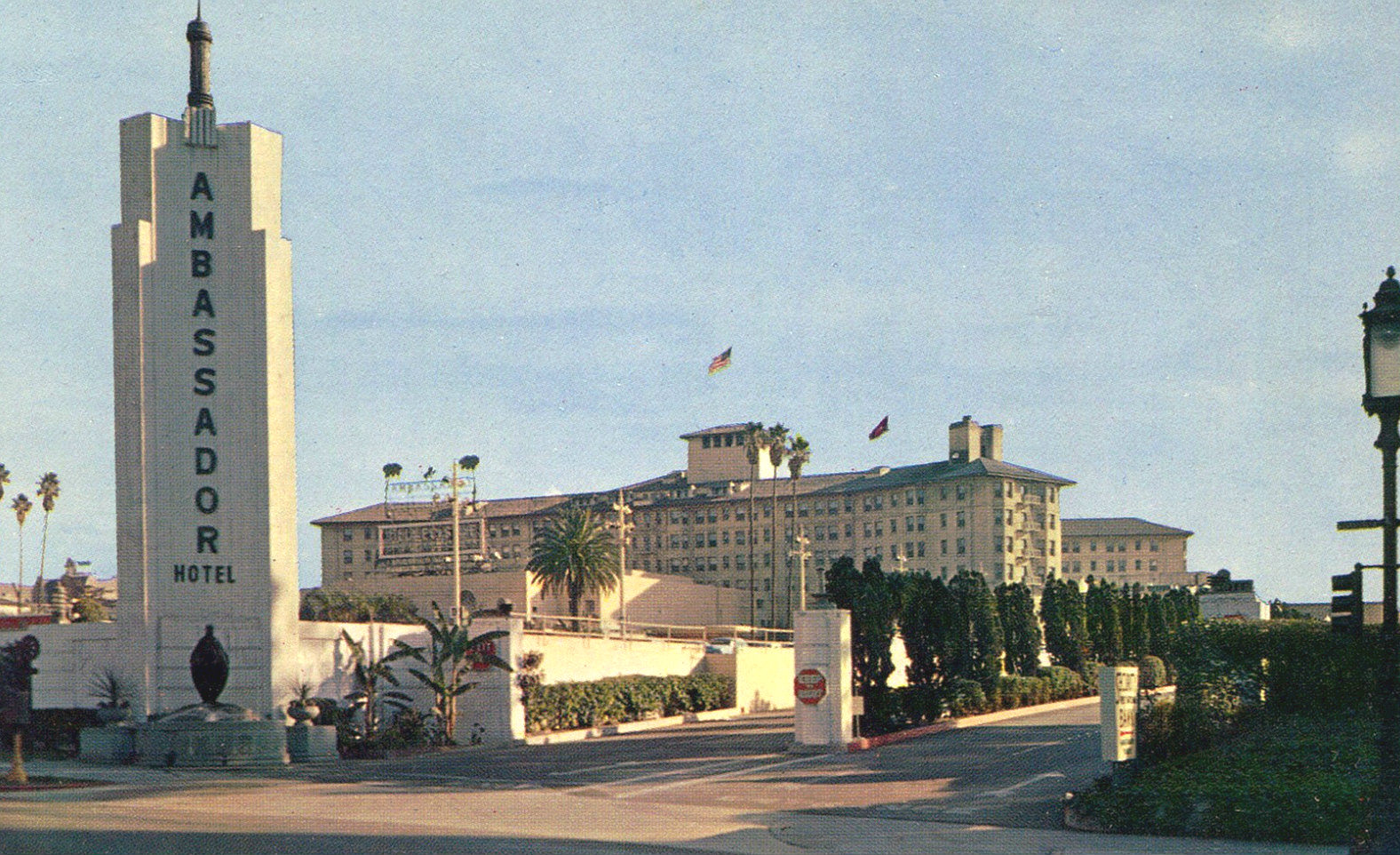
Ambassador Hotel (Los Angeles)

The Ambassador Hotel (Los Angeles), with over 1,000 guest rooms, opened at the stroke of midnight on January 1, 1921, occupying 23.7 acres on Wilshire Boulevard.  It was, until 1968, most famous for its Cocoanut Grove night club where for decades the biggest stars in show business performed—Frank Sinatra, Judy Garland, Martin & Lewis, Diana Ross & the Supremes, Barbra Streisand, Benny Goodman, Dizzy Gillespie, Nat King Cole, Bing Crosby, and many, many more.  And the biggest names in show business were in the audience, including Marilyn Monroe, Louis B. Mayer, John Wayne, Henry Fonda, Katharine Hepburn and Spencer Tracy, Cary Grant, Clark Gable, Joan Crawford, and Carole Lombard.  Crawford and Lombard frequently competed (friendly competition?) in dancing the Charleston there.  And between 1930 and 1943, the Cocoanut Grove played host to six Academy Awards ceremonies.

But then on the night of June 5, 1968, Senator Robert F. Kennedy of New York won the California primary election for the Democratic Party's presidential nomination.  He gave his victory speech at the hotel, which everyone assumed was a dress rehearsal for what would be his nomination acceptance speech in August at the Democratic Party convention in Chicago.  Instead, while leaving the hotel through the kitchen, Senator Kennedy was shot and killed.

The hotel went into a slow decline and was finally demolished in 2006 after a lengthy legal bout with preservationists led by Diane Keaton.  The property is now part of the Los Angeles Unified School District.  The District built a spacious six-story building on the site with a design that pays tribute to the design of the Ambassador Hotel.  Six separate charter K-12 schools were installed there, one on each floor of the building, drawing students from within a 10-block radius of the campus. The schools were named the Robert F. Kennedy Community Schools.
🌎🌎🌎
North by Northwest was nominated for three Academy Awards and ranks at number 55 on the American Film Institute's and number 53 on the British Film Institute's lists of 100 greatest films.

C: Robert Burks   D: Alfred Hitchcock


Sunday, November 15, 2020

Screenshot for the Week of 16 November 2020: "DOUBLE INDEMNITY" (1944)

Using Walter Neff (Fred MacMurray) and his apartment door, Phyllis Dietrichson (Barbara Stanwyck) shields herself from the prying eyes of Barton Keyes (Edward G. Robinson)in Double Indemnity (1944).


[SPOILER ALERT!] The plot of Billy Wilder's Double Indemnity (1944) began life as a real murder plot in Queens New York in 1927.  The case inspired James M. Cain to write a short novel about a psychopathic housewife who lures an insurance salesman into a murder-for-insurance scheme.  They hope to collect, not the face value of the policy, but twice the amount—double indemnity, a freak insurance rider that pays double for deaths by certain freak accidents, accidents so rare they get special scrutiny by insurance investigators[END SPOILER ALERT!]

It took eight years to bring the novel to the screen.  Time after time, teams of writers had their scripts rejected by the Hays Code office.  It took Billy Wilder and his co-writer, hardboiled novelist Raymond Chandler, to successfully translate the "gutter trash" (Chandler's phrase) story to the screen.

Cain watched the movie several times and was quite pleased with the changes Wilder and Chandler had made.  [SPOILER ALERT!] He was particularly impressed with the decision to have the insurance salesman deliver his confession to Keyes by way of a Dictaphone recording rather than by the uncinematic written statement Cain had chosen. Cain's reaction to the Dictaphone usage: "I would have done it if I had thought of it." [END SPOILER ALERT!] 

He made a name for himself with his first novella, The Postman Always Rings Twice, published in 1935.  The speed at which Cain goes from the opening sentence to the first torrid brutal sex scene takes the reader's breath away.  Even more violent and racy than Double Indemnity, it took eleven years to get The Postman Always Rings Twice to the screen.

🌎🌎🌎

John Seitz was an accomplished, respected, and ambitious cinematographer.  When he died he had 169 theatrical film credits to his name.  In addition to his film work he held eighteen patents for various photographic processes.  William Randolph Hearst personally selected Seitz to photograph The Patsy (1928), starring his mistress, Marion Davies.  At the time, he was the highest paid cinematographer in Hollywood.

Seitz's credits include the silent classics The Four Horsemen of the Apocalypse (1921) and The Patsy (1928), plus, interspersed among dozens of other films, he shot a string of Shirley Temple movies, The Adventures of Huckleberry Finn (1939)Sullivan's Travels (1941), This Gun for Hire (1942), Double Indemnity (1944), The Lost Weekend (1945), and Sunset Blvd. (1950).

🌎🌎🌎

Barbara Stanwyck worked with Billy Wilder three years earlier in Howard Hawks's Ball of Fire (1941).  Wilder had co-written the screenplay.  Both Stanwyck and Wilder earned Oscar nominations for their work.  Neither won.

Lucille Ball was originally hired to play Sourpuss O'Shea.  But when producer Samuel Goldwyn learned Stanwyck was available, he fired Ball and hired Stanwyck.

🌎🌎🌎

Charles Brackett was Wilder's writing partner from 1938 through 1950.  Brackett shared writing credit with Wilder on every one of Wilder's screenplays during that period, with one exception: Double Indemnity, which Brackett quit before the first word was typed because he found the material distasteful.  (Didn't everybody?)

Meanwhile, Brackett went on to write on his own after Sunset Blvd.  Among other projects, he wrote Titanic (1953), starring Barbara Stanwyck and Clifton Webb, and Niagara (1953) starring Joseph Cotten and Marilyn Monroe.

🌎🌎🌎

Billy Wilder only worked with Raymond Chandler once, on Double Indemnity.  They had a rocky relationship, probably because Chandler was a drunk, a mean drunk at that, and was under the influence of alcohol most of the time.  But his way with words, even while drunk, impressed both Wilder and producer Joseph Sistrom.  All of the dialogue changes from the book were more Chandler's than Wilder's.  And when Wilder and Chandler disagreed on just about any other artistic matter, Wilder invariably came to realize that Chandler had been right all along.

🌎🌎🌎


Stanwyck and Fred MacMurray worked together once before, in the romantic-dramedy Remember the Night (1940).  When it had come time for the romantic scenes in that movie, MacMurray had prepared by pacing, crying, and throwing up, unpremeditatedly of course, but in that order.  He was petrified of love scenes.  He prepared for love scenes in Double Indemnity using the same involuntary techniques.  Stanwyck and MacMurray reprised their Double Indemnity roles in 1950 for Lux Radio Theatre.

C: John Seitz  D: Billy Wilder


Sunday, November 8, 2020

Screenshot for the Week of 09 November 2020: "RED DUST" (1932)

Jean Harlow and Mary Astor in Red Dust (1932).  C: Harold Rosson.  D: Victor Fleming (uncredited).


In the early days of moviemaking, there were no standards for the content of films, no organized oversight body, only the individual movie producers and ultimately the moviegoing public.  Movies made in the 1910s, 1920s, and early 1930s were mostly family-friendly.  Many, however, included risqué sexual situations, overt sexual themes, scantily-clad or even nude women.  Some included themes involving drug use.  Some included brutal violence.

In reaction, Will Hays, the head of the Motion Picture Producers and Distributors of America (forerunner of the Motion Picture Association of America [MPAA]), oversaw the adoption of a written censorship document in 1927, a checklist of movie dos and don'ts, that was officially known as the Motion Picture Production Code and unofficially known as the Hays Code.  After some revisions it was approved by the major studio heads in 1930.

Among many other things, the Hays Code forbade "Pointed profanity" such as the words "God, Lord, Jesus, Christ," unless used "reverently," "Hell, S.O.B., damn, Gawd …"; "Any licentious or suggestive nudity—in fact or in silhouette"; "White slavery"; "Any inference of sex perversion," which included homosexuality; and "Miscegenation."  "Virgin" was also forbidden.  Criminality and immorality could not be presented in a positive or neutral light.  Criminals could never "get away with it."  Fallen women paid for their immorality onscreen by getting sentenced to prison or by getting killed.  The inside of a woman's thigh could never be shown.  A kiss could not last more than three seconds.

The Hays Code began to be enforced in late 1933 and early 1934.  The enforcement took place during production, with censors reviewing scripts, costumes, and filmed scenes.  Enforcement during this early period was spotty and some movies slipped through the censors' nets.  Many producers and directors were quite clever in dodging the censors, chiefly through the use of innuendoes and double entendres.

Movies with forbidden scenes, themes, or dialogue that had been made and released before the Hays Code—now known as "pre-Code" movies—but which were later re-released, had to comply with the Code before returning to the theaters.  Movies like Frankenstein (1931), Tarzan the Ape Man (1932), and King Kong (1933) all were re-edited to remove parts that violated the Code.  Fortunately, the censored footage for these films has been restored for DVD, Blu-ray, and TCM.  For other formats and streaming services, caveat emptor: let the buyer beware.

After the slow demise of the old movie studios in Hollywood, enforcement of the Hays Code became lax and movie producers began pushing the bounds of what was acceptable.  Movies like The Killing of Sister George (1968), with its lengthy lesbian sex scene ending in orgasm, caused Jack Valenti, MPAA president, to usher in the first MPAA Rating System (G, GP, R, and X) to replace the old Hays Code.

Since the 1990s, movie distributors have made a concerted effort to restore the edited footage from as many notorious pre-Code films as they can save and restore.  Red Dust is one of these.

The following are pre-Code films which I've seen and recommend (not an exhaustive list).[⭐ =  Essential pre-Code films]

For clarity, let me stress that when I recommend a movie, I'm recommending it only in its original theatrical release version—original aspect ratio, no ads, no editing for any purpose; or, if it had been a victim of the Hays Code, I recommend the restored edition, if there is one:

  • Animal Crackers (1930)
  • The Divorcée (1930)
  • Morocco (1930)
  • Dr. Jekyll and Mr. Hyde (1931)
  • Frankenstein (1931)
  • A Free Soul (1931)
  • M (1931)
  • The Miracle Woman (1931)
  • Other Men's Women (1931)
  • Platinum Blonde (1931)
  • Possessed (1931)
  • The Public Enemy (1931)
  • Waterloo Bridge (1931) (starring Mae Clark; not to be confused with the Code-approved 1940 version starring Vivien Leigh)
  • The Animal Kingdom (1932)
  • Rain (1932)
  • Red Dust (1932)
  • Red-Headed Woman (1932)
  • Scarface (1932)
  • Three on a Match (1932)
  • Trouble in Paradise (1932)
  • 42nd Street (1933)
  • Baby Face (1933)
  • Flying Down to Rio (1933)
  • Footlight Parade (1933)
  • Gold Diggers of 1933 (1933)
  • Hold Your Man (1933)
  • I'm No Angel (1933)
  • King Kong (1933)
  • Midnight Mary (1933)
  • She Done Him Wrong (1933)
  • When Lady's Meet (1933)
  • It Happened One Night (1934)
  • Of Human Bondage (1934)

🌎🌎🌎

Harold Rosson was one of the best and most respected cinematographers in the Golden Age of Hollywood.  Among his many credits, he photographed Tarzan the Ape Man (1932); five Jean Harlow movies, including Red Dust; Treasure Island (1934); The Scarlet Pimpernel (1934); Captains Courageous (1937); The Wizard of Oz (1939); Thirty Seconds Over Tokyo (1944); Duel in the Sun (1946); On the Town (1949); The Asphalt Jungle (1950); Singin' in the Rain (1952); The Bad Seed (1956); No Time for Sergeants (1958); and Onionhead (1958).

Like many other cinematographers, Rosson did spot work and clean-up work for directors for which he received no screen credit.  For instance, Rosson received no credit for having shot the "burning-of-Atlanta" scene for Gone With the Wind (1939) nor for having shot the "trolly song" scene for Meet Me in St. Louis (1944).

Rosson was married to Jean Harlow for 2½ years between 1933 and 1936.  He was nominated for 5 Oscars in his career but never won.

🌎🌎🌎

Harlean Harlow Carpenter was born on 3 March 1911 in Kansas City, Missouri.  She didn't have anything like the standard childhood for an actor—elementary school plays, dance class, "theatre" in high school, etc.  At age 12, however, she and her mother moved to Hollywood so Harlean could break into the movies.  Agents wouldn't take her on, studios wouldn't give her a chance: she was too old to start a career as a child actor.  She and her mother returned to Kansas City.

At age 17 she moved back to Hollywood and tried and failed repeatedly to get an acting job.  She changed her name to her mother's, Jean Harlow.  She spent months working as an extra while trying to land an acting job.  Eventually she was "discovered" by one of the stars of what would become the first of her breakout movies, Hells Angels (1930).  The studio behind the film was Caddo, run by Howard Hughes, who also produced and directed the film.  He signed her to a contract and put her in a featured role in Hells Angels, heavily promoting the movie by emphasizing Harlow's platinum blonde hair.  (The color was achieved with a mixture of ammonia, Clorox bleach, and Lux soap flakes, applied once a week.)  Hells Angels was a sensation, the highest-grossing movie in 1930, and made Harlow an international star.  But her career fizzled out almost immediately.  Nobody would hire her as an actor.  Critics said she couldn't act.  So did anyone who saw her try.

On looks alone, Harry Cohn, head of Columbia Pictures (after gaining Hughes's permission) signed Harlow to a two-picture deal. The first was Platinum Blonde (1931) with Robert Williams and Loretta Young, and the second was Three Wise Girls (1932) with Mae Clark.

Platinum Blonde is one of my favorite pre-Code films and another movie that was marketed using Harlow's hair.  The campaign worked.  Girls began dying their hair as close to platinum as they could get it.  "Platinum Blonde" hair clubs sprang up across the country.  Platinum Blonde was Harlow's second breakout picture.

Meanwhile, Howard Hughes lost interest in Harlow.  He sold her contract to MGM.  And her career took off.

Harlow could pack in audiences.  Why not give her movie roles where she didn't have to act, she could just be herself, and prominently display that hair and her charms?  Irving Thalberg set Harlow up for success with a string of such movies, including starring roles in Red-Headed Woman (1932), the third of her breakout movies, where she showed she could act with the right material; Hold Your Man (1933); Bombshell (1933); The Girl From Missouri (1934) China Seas (1935)Suzy (1936); and Saratoga (1937).  He also found featured roles for her in Dinner at Eight (1933), playing alongside Lionel Barrymore, Wallace Beery, and Billy Burke, and stealing every scene she was in; Red Dust (1932) with Clark Gable and Mary Astor; Wife vs. Secretary (1936) with Gable, Myrna Loy, and May Robson, in which Harlow stretches her acting muscles to marvelous effect; and a leading role in what would become a comedy classic, Libeled Lady (1936) with Spencer Tracy, William Powell, and Loy.  She was paired with Gable six times and played to packed movie houses every time.  Howard Hughes didn't have a clue about how to make money with Harlow.  The boy genius, Irving Thalberg, did.

I've seen nearly all her movies.  My favorite is Wife vs. Secretary.  It isn't the best film she was in.  That honor goes to Dinner at Eight or possibly Platinum Blonde.  But the best movie for Harlow—the one that best showcases her talents—is Wife vs. Secretary.  Somebody took a chance that she'd be able to act and do so in an against-type role.  She more than carries her end in this movie.  A must-see.

Jean Harlow died in 1937 of uremic poisoning, allegedly caused by her hair dye.  At the time of her death she was engaged to William Powell.  Her final film, Saratoga (1937), was released six weeks after her death.

In her brief career she went from a shooting star, quietly forgotten, to immortal superstar, still wildly popular more than eighty years later and a favorite subject of image downloads, T-shirts, coffee mugs, lunch pails, and tchotchkes of all kinds.

The word "icon" gets thrown around too frequently.  And the entertainment world has its share of them.  But it applies here too.  As a legendary actor whose face and body of work still make profits for others, Jean Harlow was and remains a Hollywood icon.

Thursday, October 29, 2020

Screenshot for a Fortnight: "IT HAPPENED ONE NIGHT" (1934) (26 October-08 November 2020)


Clark Gable and Claudette Colbert in
It Happened One Night (1934).
C: Joseph Walker.  D: Frank Capra.


Joseph Walker was one of the best and luckiest cinematographers in Hollywood history.  His list of credits would have been any cinematographer's dream, and they included Platinum Blonde (1931);  Lady for a Day (1933); It Happened One Night (1934); Mr. Deeds Goes to Town (1936); Lost Horizon (1937); The Awful Truth (1937); You Can't Take It With You (1938); Mr. Smith Goes to Washington (1939); His Girl Friday (1940); Here Comes Mr. Jordan (1941); It's a Wonderful Life (1946); The Lady from Shanghai (1947); and Born Yesterday (1950).  He was Frank Capra's favorite cameraman.  They worked together on eighteen films.

It Happened One Night showcases Walker's talent perfectly.  Watch his subtle camerawork in these scenes—at the bus stop on the road when Peter Warne (Clark Gable) chases a thief; Warne carrying Ellie Andrews (Claudette Colbert) over a moving creek; at the haystacks; and at the wedding venue.  It is beautiful work that doesn't scream, "Look at me!  See what I can do with a camera!"

🌎🌎🌎

Clark Gable worked on this movie as a punishment.  He was an up-and-coming matinee idol at MGM when he filmed Dancing Lady with Joan Crawford in 1933.  During filming he developed a life-threatening case of pyorrhea and was rushed to the hospital where he had all his teeth removed.  After surgery, he had to wait two weeks for his dentures to be made.  Instead of laying about Hollywood he took his wife on a two-week Alaskan cruise and did so without getting the approval of studio boss Louis B. Mayer nor of the head of production Irving Thalberg.

Filming of Dancing Lady continued in Gable's absence.  When he showed up on set again, Mayer docked him two weeks' salary.  But that wasn't punishment enough.  It was customary for Mayer to show his displeasure with an actor by lending him out to Columbia Pictures, one of the "poverty row" studios.  Everyone, including Gable, would know why he'd been temporarily demoted to "poverty row."  And everyone, including Gable, would read it as a career insult.  When he arrived on the set of It Happened One Night he said, "Let's get this over with."

🌎🌎🌎

Paramount Pictures didn't lend Claudette Colbert to Columbia for punishment.  She had four weeks free between movies, and she became aware that Capra was making a movie during those weeks.  After a quick negotiation, Capra promised her work would be done in four weeks, and Harry Cohn offered her $50,000 for it, roughly $975,000 in today's money.

She complained every day of filming.  She didn't get along well with Gable.  She didn't get along with Capra at all.  After her last day on set  she told a friend, "I just finished making the worst movie I've ever made."

🌎🌎🌎

It Happened One Night marked a major turning point in Hollywood.  It was the first romantic comedy to win the Oscar for Best Picture.  It singlehandedly lifted Columbia Pictures out of "poverty row."  It made major stars out of both Gable and Colbert.  (Gable and Colbert reprised their roles for Lux Radio Theatre in 1939).  And it became the first of only three movies to win all five of the top Oscars at the Academy Awards ceremony—Best Picture, Director, Actor, Actress, and Screenplay.  (The others were One Flew Over the Cuckoo's Nest [1975] and The Silence of the Lambs [1991].) 

Screenshot of the Month: "L.A. Confidential" (1997)

Russell Crowe ("Officer Bud White") dangling  Ron Rifkin ("District Attorney Ellis Loew") out an L.A.P.D. upper  floor o...